The Challenge Isn’t Data — It’s How It’s Used
Credit unions today often have access to significant amounts of data. However, that data is frequently spread across multiple systems, limiting its usefulness.
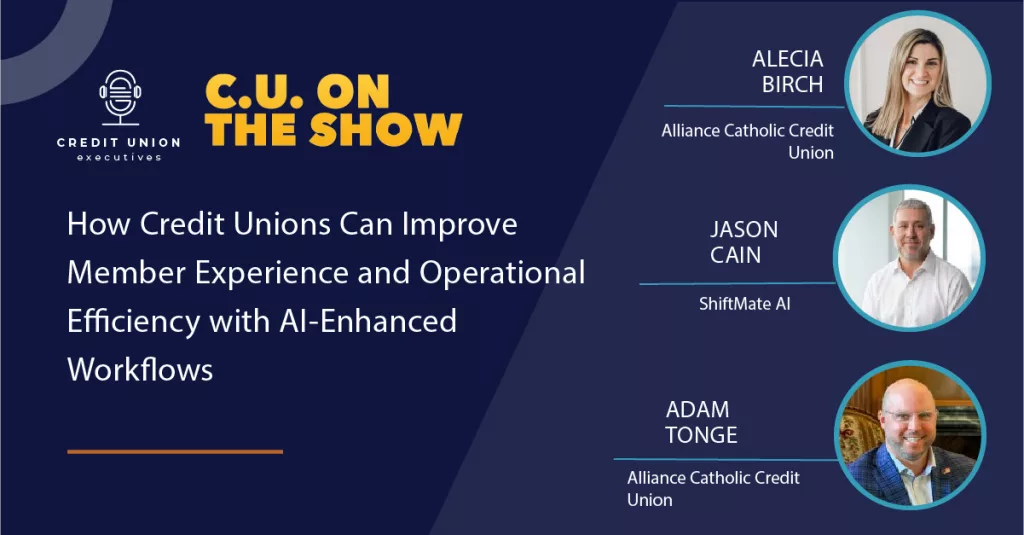
This fragmentation can create operational inefficiencies and make it more difficult to identify opportunities to support members effectively. In this episode, the team from Alliance Catholic Credit Union and Shift Mate discusses how a more integrated approach to data and workflows may help credit unions better align their operations with member needs.
The conversation provides a practical look at how institutions can begin modernizing processes while maintaining a strong member-first focus.
How Credit Unions Can Better Utilize Data to Support Member Decisions
Many credit unions rely on multiple systems to manage operations, each containing valuable but isolated information. Without a unified view, it can be challenging to fully understand a member’s financial situation.
Shift Mate introduces the concept of a “customer data profile,” which aggregates data across systems to provide a more complete picture. This may help staff access relevant insights more efficiently and support more informed conversations with members.
Having broader visibility into member data can help teams identify opportunities, validate recommendations, and provide guidance that aligns with a member’s financial goals.
How Workflow Automation May Help Reduce Manual Processes
Manual processes remain common in areas such as lending, reporting, and member outreach. These processes can require significant staff time and may lead to inconsistencies.
By introducing AI-supported workflow automation, credit unions may be able to streamline certain operational tasks. For example, systems can help organize data, surface relevant insights, and assist in prioritizing outreach efforts.
It is important to note that these tools are designed to support—not replace—staff. Human oversight remains essential, particularly in member-facing interactions and decision-making processes.
How Credit Unions Can Take a More Proactive Approach to Member Retention
The discussion also explores how credit unions may identify early indicators of member disengagement, sometimes referred to as “runoff.”
Three general categories are highlighted:
- Balance runoff (activity identified after funds or loans leave)
- Pipeline runoff (incomplete or delayed processes)
- Relationship runoff (early behavioral indicators of shifting engagement)
By identifying these signals earlier, credit unions may be able to engage members proactively. This could include outreach, financial check-ins, or reviewing available options that better align with a member’s needs.
Results will vary by institution, and success depends on how effectively these insights are implemented within existing processes.
How AI Can Support — Not Replace — the Credit Union Mission
A key theme in the conversation is the role of AI as a supportive tool.
AI-enabled platforms can assist with organizing data, identifying patterns, and improving workflow efficiency. However, they are not a substitute for human judgment, relationship-building, or member service.
Alecia Birch emphasizes that these tools are intended to enhance the credit union’s ability to serve members, not replace the people delivering that service.
Maintaining appropriate governance, oversight, and compliance controls is essential when implementing any AI-supported solution.
How to Start Small and Evaluate Results Before Scaling
For credit unions considering similar approaches, the recommendation is to begin with a focused use case.
Rather than attempting a full-scale transformation, institutions can identify a specific process or challenge to address first. From there, they can measure outcomes, assess effectiveness, and determine whether to expand further.
This measured approach may help reduce risk and ensure that any new technology aligns with organizational goals and member expectations.
Stream the Episode to Learn More
- How integrated data can support better decision-making
Understand how bringing data together may improve visibility and operational clarity. - How workflow automation can assist staff efficiency
Learn how structured processes may help reduce manual effort and improve consistency. - How to identify and respond to early member engagement signals
Explore ways to proactively support member relationships before issues arise.
Prefer to listen audio only? Listen on Spotify!
Episode Links
Audio Transcription
This content is for informational purposes only and is based on a discussion with third-party participants. Any references to technology, workflows, or potential outcomes are illustrative and may not be indicative of actual results. ACT Advisors does not guarantee any specific operational or financial outcomes. Results will vary based on each institution’s systems, processes, and implementation.
The guests featured in this discussion are not clients of ACT Advisors and were not compensated for their participation. Any views expressed are their own and do not constitute a recommendation or endorsement.