Credit union boards are expected to absorb complex information, challenge assumptions, and help guide long-term strategy. Yet much of a board meeting can still be spent receiving information rather than discussing it. Artificial intelligence may help change that by giving directors a more interactive way to prepare, explore the facts, and arrive ready to ask stronger questions.
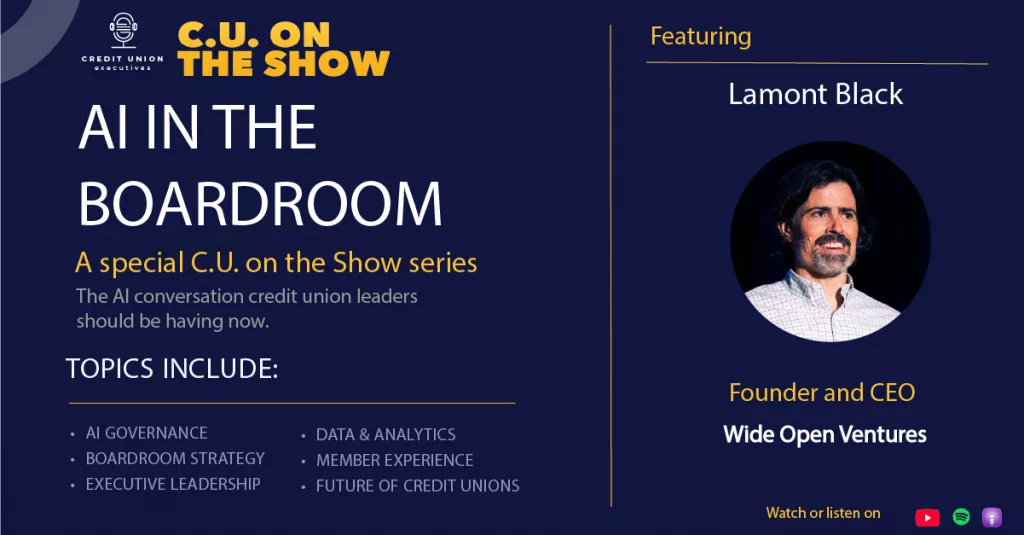
In this episode of C.U. On The Show’s AI in the Boardroom series, host Doug English welcomes Lamont Black back to examine both practical uses available now and possibilities that may emerge later. Black, founder of Wide Open Ventures and a finance professor at DePaul University, explains how approved secure AI tools could support board-packet review, strategic planning, financial scenario analysis, and more productive dialogue between directors and executives.
Use AI to Make Board Preparation More Interactive
A practical starting point is to give directors access to the credit union’s approved enterprise AI environment. With the appropriate security, permissions, policies, and training in place, a board member could use the tool to summarize portions of a board packet, clarify financial information, identify key issues, and generate questions for further review.
Black does not describe this as a replacement for a director’s responsibility to review materials. Instead, he sees AI as a way to make that review more interactive. A director who can question the material may be better positioned to understand the decisions ahead and focus attention on the issues that warrant discussion.
Engage the Board Instead of Simply Informing It
One of the episode’s central distinctions is the difference between informing a board about AI and engaging the board in its use. Credit union leaders may already be introducing AI to employees and executive teams, but directors can also benefit from education, guided demonstrations, and access to approved tools.
That engagement could encourage quieter or less-confident directors to participate more fully. An AI assistant can help a director frame a question, review historical facts, or test whether an issue deserves attention. The goal is not to move the board into day-to-day operations, but to strengthen its ability to contribute at the strategic level.
Build a Knowledge Base Around the Credit Union’s History and Purpose
AI tools may become more useful when they have relevant context. Black suggests grounding a knowledge-based assistant in authorized materials such as prior board packets, strategic plans, and the credit union’s mission, vision, and values. Subject to the institution’s governance, retention, confidentiality, and security requirements, that body of information could help the tool produce responses that reflect the credit union rather than generic industry advice.
Historical context may be especially valuable during director onboarding and strategic planning. Instead of focusing only on the latest reporting period, board members could examine multi-year trends, revisit prior goals, and ask what past results might mean for future choices.
Use AI to Expand and Test Strategic Options
Black describes strategic planning as a process that often begins with broad exploration and later narrows into specific priorities and budgets. AI could support the early stage by surfacing alternatives, challenging assumptions, and helping directors consider options that were not initially on the table. Later, it could help the board ask how proposed actions connect to financial targets, member priorities, and the credit union’s broader purpose.
Executives can use the same capability to prepare for more demanding discussions. Before presenting materials, leaders could ask an approved AI tool what questions a well-prepared director might raise and then verify the underlying data and assumptions. This does not eliminate difficult questions; it helps the organization raise the quality of the conversation.
Prepare for Faster Financial Analysis—With Human Verification
The conversation also considers a more advanced future in which AI helps automate portions of board-packet production and supports live financial scenario analysis. A credit union might eventually ask how a rate change could affect deposits, return on assets, or another planning measure and explore the result during the meeting. Black identifies this as a particularly important opportunity for finance teams because accounting and financial planning rely heavily on structured data and defined rules.
Reliable output still depends on reliable inputs and review. Black emphasizes that AI-generated analysis should not be accepted on blind faith. Credit unions will need appropriate human verification, access controls, data governance, and a clear understanding of which sources the system is using before relying on its output in board decisions.
Start With the Tools and Governance Already in Place
Credit unions do not need a perfect enterprise data environment before they begin learning. Black recommends starting with the institution’s approved AI tool, extending suitable training to the board, and testing a defined use case such as secure interaction with a board packet. Leaders can compare the quality and depth of board discussion before and after the pilot while documenting limitations and lessons learned.
Over time, better-integrated data may allow boards to ask deeper questions with fewer delays. But the near-term opportunity is simpler: help directors prepare more effectively, arrive with greater confidence, and spend meeting time discussing information rather than merely receiving it.
Stream the Episode to Learn More
A practical first use case — Learn how an approved enterprise AI tool could make board-packet review more interactive and help directors prepare focused questions.
A stronger strategic-planning process — Hear how AI may broaden early brainstorming, test assumptions, and support more rigorous board-level discussion.
A view of the future boardroom — Explore AI-assisted board-packet automation, financial scenario analysis, natural-language access to data, and agent-like perspectives—with security and verification remaining essential.
Listen to the Full Conversation
Stream the full episode of C.U. On The Show to hear Doug English and Lamont Black discuss how credit union leaders can begin involving their boards in AI today—and how those early steps may prepare them for a more interactive, data-informed boardroom.
Prefer to listen audio only? Listen on Spotify!
As a credit union executive, your compensation package may include complex benefits such as 457(f) deferred compensation and split-dollar arrangements. Coordinating these benefits with your financial, retirement, investment, and tax planning can require careful preparation. ACT Advisors is a fee-only fiduciary financial advisory firm that works with credit union executives. Learn how a coordinated financial plan can help you better understand your executive benefits and prepare for your financial future at actadvisors.com/cuexec.
Episode Links
Audio Transcription
This transcript has been lightly edited for readability, grammar, punctuation, and clarity. Filler words, transcription artifacts, false starts, and repeated words may have been removed.
Doug English: Welcome back to CU on the show and our series on AI use in the boardroom. Now, in our previous episodes, we’ve talked about the governance around the setup of AI use in the boardroom. We’ve given to you some examples of how, actual credit unions are using AI in the boardroom. And here to look at how AI might be used in the future in the boardroom, we have our future-seeing Lamont Black back on the podcast again to help us, see the future of AI in the boardroom. Lamont, welcome back.
Lamont Black: Thank you, Doug. Great to be here.
Doug English: Well, how is your future seeing, going, these days? Are you seeing the like, what’s, what, what, what am I going to have for lunch today, Lamont? What, what do you see? What do you see out there? Now, you
Lamont Black: Well, I am a futurist. I don’t know if I have a crystal ball or not, but, yeah, it’s, it’s a fascinating time. It’s a great time to be alive. I feel like there’s so much changing. It’s a great time to be in my role because, I feel like everybody’s asking questions, trying to figure out where this is headed. I know we’re going to talk about AI today, but stable coins, tokenization, all of this, like, it’s, feels like a bit of a hockey stick moment.
Doug English: It, it’s incredible, and the, the rate of change in the models and the open source versus the, frontier models in the US is something I, I, I kind of geek out on a bit. We’re not going to do that today. We’re staying focused on AI in the boardroom specifically, ’cause I wanted to make it tangible and, and and useful, implementable by credit unions, which is why we’ve kind of gone through these series of steps. So when you, you know, you talk with and consult with many credit unions around the country, what do you see credit unions starting to do with AI in the boardroom right now where it’s actually… How do you see it being used at this time?
Lamont Black: Yeah. So I think you’ve talked to some of your other guests about kind of the role of the board as it relates to AI, talking about governance, talking about kind of setting some of those broad guardrails, but, just practically, like the day-to-day work of a board member, the thing that, I see happening now, which is, you know, not at many credit unions, but, headed in that direction, is providing access to the board members to use AI. So, a lot of credit unions are on Microsoft Copilot, most of the, the full executive staff has it, and then they’re kind of rolling it out kind of below the executive team down into the organization. What I’m starting to see are conversations of those tools being made available to the board members. So a great example of that is, you know, when a board member gets the board packet, instead of assuming that they’re going to read the whole thing, which, you know, would be a generous assumption for most of them, for them to be able to upload that board packet into a secure environment like Copilot, something that’s already been established with all those, guardrails in place, and being able to start asking questions, you know? “Help me understand what’s going on with the credit union.” Even, you know, thinking through financials, reading through and summarizing some of that information. That might sound a bit like a shortcut instead of reading it old school, but what I find is that that makes it more interactive. It allows the board members to start kind of figuring out what are the key issues so that they can sift through it more effectively. So, you know, all the advantages that we’re seeing of AI as a productivity tool within the organization, I think we’re going to see more and more of that extending directly to the board.
Doug English: Yeah, and the, I, I think I love the idea of the, the board member you know, is preparing to potentially have to make some decisions. And so they could use that, interactive nature of AI to ask, it, to help it think through the decisions about what are the strengths and weaknesses of the idea, what do I need to know in order to make a good decision about this idea. have you seen credit unions actually doing that or, or talking about doing that?
Lamont Black: I have seen board members, you know, asking for it. So I do a lot of board education around AI and, when we get into the discussion about use cases, and typically around training and deployment throughout the staff, there are more and more credit unions where the board members are starting to say, “Well, hey, what about us, and what can we do with it?” One thing I have done with board members is, like, live interactive demos, so having them pull up, you know, an AI tool, and we do some prompting and getting them thinking about it. You know, I think credit unions are still a little bit careful around the data security, but I think the ones who feel like they’ve been able to lock down that sandbox, and they feel okay about putting that level of, confidential information into it, that’s obviously a, a hurdle that has to be surpassed. But, you know, I have not been in a situation where there’s a board that’s like everyone’s using it and, you know, it’s, they’re all rocking and rolling. But what, another thing I want to say about boards is there is still this idea, I think, amongst some credit union executives When they’re talking about AI, they are, like, informing the board versus engaging the board.. And I think that’s a very important distinction because there are still some executives that I think they, they know they serve the board and, you know, that the board ultimately writes their checks, and so they need to kind of keep them up to speed, but I think they’re nervous about really pulling the board into more of a conversation versus just a one-way, direction of just communication. And, and I personally feel like AI helps them figure out what are the right questions to be asking, the right decisions to be making, like you were saying, and, you know, I’m I’m sure there’s a fear that they might start to get into the weeds, get into some operational things, but ultimately, you know, AI is a strategic thought partner. You know, I think a lot of credit union executives are waking up to that. Don’t just treat it like an intern to write your emails, but use it to bounce ideas off, to think about different strategic initiatives. And to the extent that the board is engaged in strategic planning, they should be taking advantage of AI as that type of strategic thought partner.
Doug English: Hmm. Can you I, I very much agree, but can you keep going on the how would AI be a strategic thought partner? And again, I know you haven’t seen a lot of it happening yet, but imagine how might AI function as a strategic thought partner? Like, how might you set it up, and then are you imagining a live interaction or a before the meeting? Just hypothesize, if you would, please.
Lamont Black: Yeah. I think it’s, all of the above, but let me walk through the process. So, you know, a lot of credit unions have kind of a two-cycle strategic planning process. Some of them, like, it’s spring and fall.. Spring is the more open-ended brainstorming big ideas. Sometimes I get brought in in the springtime to kind of broaden the conversation, artificial intelligence and emerging technology often being part of that, and then the staff takes all those conversations, and they try and come up with a more concrete, tangible strategic plan and often, like, annual budget going into the fall sessions. So I would love to see more use of AI by the board in the spring, for instance. Any sort of pre-read materials, any type of board package that they’re receiving, being able to engage that with AI prior to those days, typically let’s say two to three strategic planning conference. They should be having access to kind of prepare their thoughts and their ideas prior to that event. And then I think even in real time in those sessions, you know, people being able to think through not just like the why, but also the what, and even a few conversations about the how. I don’t think it changes anything about, like, mission, vision, and values. So, like, those are core, and the more the AI tool understands who the credit union is, what is their core mission and purpose, then it’s going to be able to tailor those conversations about, okay, what are your strategic objectives given that context? And a lot of credit unions have, I’m finding, kind of a twofold strategic plan in a broad sense. There’s kind of a financial element, and then there’s a member element. So, like, financial, it could be, like, an asset growth target. It could be an ROA target. It could be a capitalization target, things like that. And then some type of member focus, like are we trying to grow membership? Are we trying to deepen membership? Are we trying to convert indirect members? Those types of conversations. And so once you have a sense of, like, the North Star, there are so many different ways that you can approach strategic planning so that you’re not choosing any individual path too quickly. So that’s where, like, in the spring, the, the value of a thought partner is helping you ask questions you hadn’t thought of or ideas you wouldn’t have even considered. So instead of saying, “Okay, here’s the three options, and we’re going to debate these three options,” I think AI could say, “Well, what about this?” Or, “Have you thought about that?” So in the spring, it should be this sort of, like, brainstorming, support, and then moving into the fall, if there is this kind of divergence-convergence cycle in the strategic planning, starting to process. Like, okay, we’ve defined some of the big objectives, now what are some of the ways we can try and get there? And again, you don’t want the board doing operational work, but helping them get from kind of big-picture idea to understand those staff kind of implementation issues and fleshing out that in between because, like, one of the challenges I’ve seen in the strategic planning process is the board gets engaged early on at the very high level. They have some cool interactive discussions, but then the, the executives go back, and they build a strategic plan. And in the fall, it comes back to this like, “Here it is. Give us a thumbs-up or thumbs-down, and then we’re going to move on.” And you lose that interactive component in that back end, and so I think that’s where, like, an AI tool can help them think about, like, well, there’s different ways to achieve these outcomes. Have you thought about this or thought about that? Not necessarily the board defining it, but board asking harder questions. And this is where the executives, the CEO in particular, really has to ask themselves, “Do you want the hard questions?” Because if you want an easy board who’s just going to, you know, give you that thumbs-up, don’t use AI. But if you really want to make it real, fierce, and, like, let’s roll up our sleeves and have a hard conversation about this, I think AI is going to empower the board for those conversations.
Doug English: Yeah, you know, one of the things that you said that, that really struck a chord is that the degree to which the AI understands your mission and vision, your credit union, your membership base, your, strategic plan, the better job it’s going to do in helping you. Doug, could, could it also, you know, you’re not necessarily trying to change the nature of the board, you’re trying to enhance the board to do their job more effectively. couldn’t you… so in the first place, teaching it about your credit union, how would you suggest credit unions think about doing that? What would be the method of teaching it about your credit union that you might suggest?
Lamont Black: Yeah. So I think a lot of executives are now familiar with the idea of a knowledge-based assistant, so having kind of a body of knowledge and then an AI agent that can pull or retrieve from that information to give different responses. so the, the… I think the, the… where the narrow thinking comes in is people think, “Oh, well, we need a knowledge-based assistant for our contact center,” or, “We need a knowledge-based assistant for this department or that department.” But the same principle applies to the board. So instead of thinking about it as, like, a long prompt and we’re going to, like, guide it this way, it’s… I would think of it more as a body of documents. Where is it pulling from? And that could be all of the board packets for the last five years.
Lamont Black: And so that’s, like, the repository. So it’s also not like, let’s pull up a fresh chat and just, “Hey, by the way, we’re doing this today. What do you think we should do?” Like, no. No.
Lamont Black: It’s… you build that conversation, you build that history so then it has all those previous documents and says, “This is where we’ve been over the last five years. These were our successes. These were our, kind of, shortfalls. What can we learn from, what can you learn from that history that you can help inform us?” Because part of what you want the board to do is to not have kind of, like, that, just that short-term memory where they’re only thinking about the here and now, especially if you have new board members that you’re onboarding, especially helpful for that, giving them that longer trajectory. And then also, like, giving them a bit more of that longer-term memory. No offense to board members but, you know, as we age, our memories tend to depreciate, and you want to bring all of that history into those conversations, and having an assistant who has all that information at its fingertips can be super helpful.
Doug English: Absolutely. Yeah. and the… you know, there’s the issue that, sometimes might occur where there’s kind of a strong personality in the Yes who tends to really lead the group, and, the others just sort of kind of go along with that. And go ahead, Lamont.
Lamont Black: Yes. I, I fully agree with that, and sometimes the strong personality is within the board, sometimes the strong personality is within the executive team. Exactly, yeah.
Lamont Black: And for good governance, you want to have a mix across the board and executive team. That’s… Like, strategic planning is not effective when it’s lopsided or one-sided. You want to have a, a real dialogue between the two. And what I have found is that with some boards- You know, the, the people who are a little more quiet might be because, A, they didn’t read the packet-… or B, they’re less confident. Like, do I really know what I’m talking about? You know, do I feel like I have a strong grasp of the material? Do I really know, is this a good question or a dumb question? And if AI is helping them frame those questions, that’s going to build their confidence, and they’re more likely to bring that convers- question to the conversation. So I think it balances out some unequal boards. And here’s one other thing I just thought of, is it grounds them more in the facts. So, you know, it can be very hard for a board to feel like they have the information they need, so it… Some, some board conversations I’ve been at, it turns into the board asking the, the staff, “Well, what’s going on with this?” Like, “What’s going on with membership growth?” Or, “What has asset growth been in the last three to five years?” Or, “What’s ROA?” And, and it, you know, the board tries to, or the, the team typically tries to anticipate those questions in the board, like, slide deck of, like, here’s a chart of this, here’s a chart of this, here’s a chart of that. But again, that becomes we are telling you, instead of the board asking questions. And if the board has more of those facts, they don’t have to ask the team for that information. They can say, “Well, hey, I’m looking at this and it looks like, you know, these were the numbers the last three to five years. Where do we expect this to be headed?” So then it becomes more discussion about ideas and strategy and not, you know, asking questions that are factual in nature.
Doug English: You know, you said something a minute ago that I would feel very intimidated by if I was the CEO, is the idea that, we’re going to give all this power of the world’s knowledge to the board, and they’re going to come to me with much harder questions that, could be, could be very intimidating. It seems to me that, like, there would be an opportunity to get ahead of that, right?. Couldn’t you as the executive team say to the AI agent of your choice, “All right, here’s the information that we’re presenting to the board. Here’s the subject matter. what would you, suggest the board members discuss? What questions would you suggest the board members, get?” And then work on those in advance. What are your thoughts?
Lamont Black: Yeah. I think it’s a great idea, and I think you’re right. It kind of raises the game.
Lamont Black: As an executive, you can’t just depend on your slide deck, your board packet, and say, like, success of strategic planning conference should not be, we got the board to assent. Mm. Like, that’s not an engaged board. That’s like a rubber stamping board. Like, you want a board who’s going to ask those hard questions and, and you and AI. You can use AI to help you prepare for those questions- Yeah… just like you suggested. Here’s another analogy, which, which was from a credit union board member. We were at dinner. This is a gentleman who’s in his late 70s. And he was talking about how he has started using ChatGPT to help him with his health diagnoses. You know, we, we all have health issues, especially later in life.. And he’s not using it as a doctor. He’s just like, “Hey, I’m having these symptoms. can you help me think through this?” And it, he, he’s using it as a way to prepare for his doctor visits
Lamont Black: so that when he goes to see his doctor, he’s like, “Hey, like, I’ve been learning about this, and I’ve, I now have this question.” And he’s, and he’s asking harder questions of his doctor. And it was, what was so funny is he said his doctor started to get intimidated. Hmm. And it, it was making his doctor a little more uncomfortable because now the doctor wasn’t the only expert in the room. Yeah. He was coming more informed to those doctor visits, and I think it’s a great example of, like, it elevates the conversation. Yes, it’s going to make it more uncomfortable, but it’s also going to make it more productive.
Doug English: Yeah. Everyone raises the bar, and hopefully the member, comes out ahead. Now, the, the, we, we’ve been talking about how to, to use it to prepare the board in a traditional sense. go a little further with your future thoughts about how we might be able to automate some of that and involve some agents, in any of this activity.
Lamont Black: Yes. Well, first of all, automation of the board packets, I think that’s coming. I think there are credit unions that are already working on that. Like, creating a board packet can take a lot of time, and, the automation, especially of the, like, the accounting and financial matters, I think, you know, a lot of it involves aggregating different data sets. all of that should be integrated so it’s just a click of a button.
Doug English: AI is great at that kind of thing, yeah.
Lamont Black: Say it again.
Doug English: Yes. I said AI is great at that
Lamont Black: kind of thing. Yes. Yes. And then the agent piece… Here, I’ll give you a radical idea to go along with this. Imagine if every credit union sort of had an imaginary AI agent as, a non-voting board member. So think about, here’s, like, think about, like, I don’t know if you remember Star Wars, it was like next generation, – It’… Data.
Doug English: Star Trek, my friend.
Lamont Black: Star Trek. Star Trek. Star Trek, yeah, yeah. My, my
Doug English: And I remember it very well.
Lamont Black: Yes. So remember, like, Data was, like, this kind guy who brought those types of, like, more statistical, more rational
Lamont Black: perspectives into the conversations that sometimes balance out the human emotion. and, you know, instead of just using AI as this, like, reactive prompt, response, prompt, response, part of an the idea of an agent is it becomes more proactive- and it starts sort of prompting you, and it starts sort of introducing new ideas into the conversation. And I just, I imagine a world where, like, artificial intelligence isn’t just, like, a support to people as, like, a tool. It becomes, again, more of a partner. Now, I know this, it can get scary of, like, AI taking over and things like that, but, – Really like viewing it as part of the conversation, where like every board conversation, I think, should be recorded and processed by AI. The whole idea of having like a a board secretary, I think that should go away. We should be doing every, even live meetings, we should have a set of microphones, everything’s being recorded and transcribed, AI is processing it, you know, putting it back out to the, to the group. And then, but then layering on top of that, an agent who is continually, like, reviewing that material and making suggestions and saying like, not just, “What did so-and-so say, and what did so-and-so say?” But like an additional voice, which is really what an, an agent is, which is providing that third perspective that may not have been in the room.
Doug English: . Yeah, it could be the, the, the voice of the regulator, the voice of the member, right? If you had specific agents that you trained on, particular outcomes or, or voices that you wanted to make sure were a part of the conversation.
Lamont Black: Yes…
Doug English: seems like that is where the, the puck is headed, if, if you will. and, and you know, I, I’m looking actively if any of you listeners have knowledge of credit unions that are actively doing this, we would love to hear from you. We want to have these conversations and normalize the use of AI in the boardroom, and try to give examples of how credit unions are actually, doing, using AI in the boardroom right now. So let’s go further on, on about, financial modeling. – Yes… and, you know, you get the, the board packet and you’ve got the data in there that’s, you know, PDFs or, or whatever, spreadsheets perhaps. but you’re not, you’re not able to do any live, simulations, live modeling. what are your thoughts around how that might change?
Lamont Black: Yeah. I think in particular- AI could transform the role of the CFO more than anyone.
Doug English: Mm.
Lamont Black: Like, there is not enough conversations around this. People think of AI adoption in credit unions around member experience, contact center, lending, things like that. I’m a finance guy. That’s my training. I teach finance at DePaul. So when we do our, like, AI consulting, we’re, we’re working with the full executive team, my conversations with CFOs are often the best conversations because they are the ones who are recognizing, first of all, finance is built on accounting, accounting is built on data, accounting is a set of rules applied to data. And so there’s no reason AI can’t learn those rules and apply those rules, and then finance is just, like, the interpretation of accounting. And to your point, finance is the more forward-looking component. Accounting tends to be more backward-looking, finance more forward-looking. That’s what gets you into, like, forecasting, predictive analytics. That’s AI’s strength. And so this idea of, like, AI is helping us do, like, reconciliation on the accounting team, so, like, the controller’s really excited about that. But then this idea of, like, scenario analysis, that’s where the finance people should be really weighing in because what I find, especially with strategic planning, is like, well, let’s do a few scenarios, like 25 or 50 basis points on the federal funds rate this way or that way, and then it gives us this kind of like range. Maybe we do some Monte Carlo simulations. But Ideally, it’s, you know, you’ve got an AI agent and you, it knows all the accounting data, and then you say, “Okay, if monetary policy shifts in this direction, what happens to deposit runoff, or what happens to our ROA?” Things like that. Yeah. because here’s an example. I did this just recently for a strategic planning session. I was, like, asked to do the kind of economic environments presentation at the very beginning, and we talked about where we are in the rate cycle, what’s going on with GDP, unemployment, things like that. Then we started talking about the credit union’s financials, and their kind of one, three, and five-year plan for where they wanted to go with assets and ROA.. But those should be integrated. Of like, okay, if the rate cycle does this, here’s our financial outlook. If the rate cycle does this, here’s our financial outlook. One of the people, kind of the, the consulting side I’ve been talking more to, or the whole, like, ALM, asset liability management consultants,
Lamont Black: more and more they’re bringing AI around the edges, but, like, they need to flip their whole business model. No more Excel, no more proprietary models. Like, you are an interface to these large language models to help your clients figure out how to do this type of strategic planning.
Doug English: Yeah. Yeah, and do it… and it’s live, and it’s, it’s part of the conversation, and you don’t have to rebuild the model later and then send it to the board members after the meeting is broken up the momentum has been broken, right? Yes. But the idea is, is you can potentially do it live if you trust the data, and that’s going to be the real catch, right? Is that you’ve got to, validate that the data that it produces is right. Have you, have you seen any good methods of doing that, or had thoughts around how you would validate, on-the-spot projections were correct? ‘Cause we certainly don’t want to lead your board in the, down the wrong direction because you’ve got bad data.
Lamont Black: Yeah, I mean, there always needs to be that verification process, and that’s a good principle for using AI in general. Like, don’t just take it on blind faith. But, yeah, so I’ve started developing this, like, AI adoption framework that we’re leading our clients through and, you know, a lot of it has to do with, like, leadership alignment and then, you know, organizational change, how do you get it down into the staff, and, training and things like that. But the way I’m thinking about it right now, it’s, it’s, it’s a seven-part framework. That seventh piece is what I call the data frontier, which is, you know, ultimately AI is an application of data, and this is going to be an ongoing process, not like a check the box of how do we continue moving our data to the frontier so that we can get the most value out of AI, and that’s shifting the mindset from, like, focusing on the core or we’ve got a data warehouse. You know, I think more of the credit unions are waking up to this idea of a data lake or a data lake house, Typically, again, that’s with a third-party vendor, and so they know the words, they don’t necessarily know how it works. But, like, again, just think of it as, like, an integrated data repository where AI can, like, connect to data across the organization, not these data silos, and starting to use AI to do some of that data cleaning. This is, I think, a concept some credit unions haven’t woken up to. It’s this idea of like, “Oh, well, we have to get our data perfect, then we can start using AI.” Well, AI can actually help you find some of those issues, and it can start doing some of that cleanup work for you. And part of why I think board packets and financial analysis and scenario planning, why those things take so long is typically there are multiple sources. Sometimes there’s not a single source of truth, and so the CFO has a team, and they’re going out and pulling this and pulling this, and then they’re doing all these merges, and then trying to get everything stitched together, and then they’re, “Well, these numbers don’t quite line up.” That’s, you know, when I,.. One of the boards I work with, we started using the phrase data shoveling. There was so much data shoveling involved that actually building any, any analysis is, like, 5% of the work, and 95% of the work is just getting all the data aligned and, and, ready. And so you want to shift that so the data shoveling is only 10 to 15% of the work. That, and, so the, the easier it is to get the data, the more questions you can ask. And I think that’s a great principle for both executives and the boards. Make the data easy, and then you’re going to elevate the conversation because now people can ask deeper questions.
Doug English: . Yeah. and does, does the board meeting of the future, is it a set cadence, in your opinion, to the, the monthly or quarterly, meeting frequency, or does it become, based on circumstances at some point, where there’s alerts that come from the system as to when you might need to address something? hypothesize, if you would, about how that might work.
Lamont Black: Yeah, I think there’ll still be a regular cadence of meetings. Part of that’s regulation, you know, requirements for boards. but I think what’s going to change is the way people access information. Not so not necessarily the way people- talk about that information. So, like, a meeting should not be people receiving information
Doug English: Mm…
Lamont Black: which is what most meetings are.
Doug English: Yep.
Lamont Black: Meetings should be people discussing information. So the same thing, like, I teach at DePaul University. Higher education is going through this whole process. It’s called, it’s called the flipped classroom. The classroom is not where I provide information. Ideally, I provide information prior to class through videos, podcasts, things like that, and then the classroom becomes the workshop. Ideally, a board session is a workshop, not people sitting there listening for 55 minutes and then having five minutes of Q&A. And so doing more of that interactive work in advance. And another term, and I, I believe I’m the one who actually coined this. Ooh. Here we go. ABI, artificial business intelligence. So if you take business intelligence, which has been around a very long time, and then you take artificial intelligence, which is relatively new, combine the two, you get artificial business intelligence. And that is AI applied to business intelligence, so that now if I have questions for the data, I’m, I don’t have to use Excel, I don’t have to use Power BI, I don’t have to use SQL. I now have a natural language interface where I can ask a plain English question, and I can get answers from the data. Now, most people are thinking about that. There’s a lot of credit unions starting to wake up to this on their IT and data analytics teams, but they’re thinking about it more from a staff perspective. Our conversation is let’s bring the board into that, so now they’re not just querying PDFs. Ideally, at some point, there is an interface between the board and the data lake. Yeah. Whoa.
Lamont Black: Well, yeah. Whoa. That, that’s a whoa, yeah.
Lamont Black: Whoa. Yeah.
Lamont Black: Right? But dude, if you got it secure and if the data’s right, like think of it as a playground and say, “You got questions? Go for it.” Yeah. Because right now, the question goes to the CEO, the CEO sends it to the head of analytics, the analytics sends it to an analyst, they produce a spreadsheet, and it’s just like this chain back and forth, and there’s all kinds of bottlenecks and lags and delays. Give them the API and say, “Go for it. Now you’ve got your language interface. Give it a rip.”
Doug English: Yeah. Wow, now, and, and, and the, the core to being able to do that is actually having a single source of truth, right? That’s that data warehouse, data lake, being created and, and potentially a, a substantial undertaking in order to do that. Now, I, I, I, I’d love to talk about that more, but what we’re trying to focus on today is, is what you can take away and implement with your board, with your board packet, with your strategic planning process. And, the, the idea of the data lake and data warehouse, I think that, that’s something I’d love to talk about with you as its own separate, podcast, ’cause I think they’re, I think that’s necessary. I, I know in, in my investment firm, we are trying to do exactly that with data all over in these different places. Credit unions have way more spread out data than we do, and it is difficult to do. It is expensive. It is hard to know which way to do it, ’cause it’s not all, it hasn’t been done for years. It hasn’t been done for maybe just a few months. and it’s really difficult to, to figure out how to do it. and then of course, we have regulations just like credit unions do that, where we have to make sure everything is secure. the, am I right, Lamont, that the data warehouse, discussion is something that is so substantial that might need to stand on its own, or is that something we can briefly unpack?
Lamont Black: No, I’m happy to come back for that conversation. I, and that is, I just want to reiterate, like, as I’m developing my AI adoption framework, right now I’ve got seven points. data frontier is the seventh point. It is not data foundation being the first point. So it is not like a gatekeeper to AI adoption. It is more once you figure this stuff out, that’s where you can start to really run with it. And so I don’t want anybody to walk away and say, “Oh, well, we gotta do all this prep work before- Yeah… we can explore any of this stuff.” Yeah, no. I fully agree with you that that’s where this is headed. It doesn’t mean that’s where you have to start.
Doug English: So, let’s pretend that there is a listener, that is a credit union executive and, has not implemented any form of AI with the board yet. How would you suggest they consider starting, and then any resources that you have or the industry has that you suggest that they might look at to get started?
Lamont Black: Okay. So most credit unions have a preferred AI tool. Let’s say Copilot, maybe it’s Claude Enterprise, ChatGPT. Most of the time it’s Copilot. So to the listener, have you considered making that tool accessible to your board and starting to do some of, some board training, board education around use of that tool, just like you’re doing with your executive teams and probably with your leadership team, and so expanding that mindset to include the board. And then once you onboard the board onto that tool, and I, I would encourage you to, if you’re using Copilot, give them a 365 license. You know, give them some of that additional, features and functionality. And then the first step would be, you showing them how to upload the board packet into Copilot and start asking questions and interacting with the board packet. So before your next board meeting, or at some, some particular board meeting, once you’re ready, do all that prep work, explain to the board, maybe it’s one board meeting, you say, “Hey, this is what we’re doing. We’re going to onboard you, and before our next meeting, we want you to come having done this work.” And I would just challenge you to try and measure that before and after. So get the baseline, what does a board-engaged discussion look like before doing that, and what does a board-engaged discussion look like after doing that? And my prediction is that you will see an impact for the better. It’ll be harder. It’ll, there’ll be moments where it’ll make you more uncomfortable, but there is nothing stopping people from doing that today with their board. Most credit unions are doing it with their staff. Expand it to include your board, and I think you’ll see many benefits
Doug English: What, what a great takeaway, and again, I would remind our executives that you can get ahead of those questions. You, the information that you would give the board, you can go to your AI and ask it itself what questions would you generate for a board member that is preparing for this meeting from our data. and, and know what those questions are, be prepared to answer them well, and in doing so, perhaps take some of the worry away from this new, initiative that I think, I think we need to see a move across the credit union movement, to continue to keep up with what the fintechs are doing, certainly what the bankers are doing. credit unions must win the adoption of AI, and, and we’re here to try to help, make that possible. Lamont, thank you so much for, for your time today, and your great, great content. any, of your resources that you might suggest that our, listeners reach out to, to, to, to gain more knowledge of, of how to implement AI in their credit union or, to, to use your services to help them do so, what would you, where would you suggest they go to look?
Lamont Black: Yeah, so I do a lot of speaking and consulting on these topics. If they’re looking for board education, things like that, they can find me at lamontblack.com. If they’re interested in the consulting and the AI adoption piece, that’s wideopenventures.com. So my company, Wide Open Ventures, happy to support you on this, learning and adoption journey. And, very active on LinkedIn, happy to connect with folks there.
Doug English: Very good. Well, we, I will, take you up on the, opportunity to discuss the, the single source of truth, the data warehouse model that, I think, many of us are going to need to create in order to be able to fully, get the the benefits of automation from AI. AI needs good data in order to produce good automation. I think that’s where the puck is headed. So until then, Lamont Black, thank you so much.
Lamont Black: Thank you, Doug. See you soon.
This content is for educational and informational purposes only and is based on a discussion with third-party participants. It should not be construed as investment, legal, cybersecurity, privacy, compliance, data-governance, or operational advice. Credit unions and other organizations should evaluate data collection, artificial intelligence, and related technologies against their own policies, regulatory obligations, information-security requirements, vendor due-diligence standards, and legal counsel guidance. Any references to technology, workflows, or potential outcomes are illustrative and may not be indicative of actual results. ACT Advisors does not guarantee any specific operational, governance, member-service, or financial outcomes. Results will vary based on each institution’s systems, processes, controls, policies, data quality, and implementation. The guests featured in this discussion are not clients of ACT Advisors and were not compensated for their participation. Any views expressed are their own and do not constitute a recommendation or endorsement of ACT Advisors or its services. References to third-party organizations, platforms, or resources are for identification and discussion purposes only and do not imply endorsement, sponsorship, affiliation, or approval by those third parties.