Measure Member Impact Alongside Financial Performance
Financial metrics remain an important part of evaluating a credit union’s financial condition and performance. However, Tansley explains that financial results may not fully reflect the broader role of a cooperative financial institution.
At Orsa Credit Union, traditional measures are considered alongside impact-oriented questions. These include how the credit union is serving first-time homebuyers, supporting women pursuing homeownership, helping members reduce certain costs, and assisting people as they work toward financial goals.
Tracking these types of outcomes may help a credit union evaluate whether its strategy is producing the intended results. It may also help the organization communicate its mission and community role in more concrete terms. Purpose statements can describe an institution’s goals, while supporting data may help illustrate how those goals are being pursued.
Use Data to Better Support Members
Jamie describes personalization within a credit union as a potential form of member advocacy. Rather than focusing only on which product might be offered next, a credit union can consider how available information could be used to better understand a member’s needs.
Member information may help a credit union identify opportunities to provide relevant education, recognize signs that a member could benefit from assistance, or offer timely information that may support a financial decision. The usefulness of these efforts will depend on the quality of the information, the organization’s processes, and the context in which the information is used.
This type of personalization should remain connected to member value. Credit unions should understand why they are collecting and using information, communicate appropriately, and avoid treating personalization as a purely transactional sales tool. Thoughtful and transparent use of information may help support stronger member relationships.
Create a More Reliable Source of Data
One of the challenges credit unions may face is that member information often exists across multiple systems. Developing a more complete view may require information from the core platform, digital banking system, lending software, accounting platform, marketing tools, chatbot, and contact center.
Jamie recommends beginning by bringing relevant information into a more centralized environment. The organization can then work to establish consistent definitions, governance standards, and processes so employees have a clearer understanding of the information they are using.
Even a seemingly basic term such as “active member” may have several definitions within the same credit union. Reaching agreement may require participation from leadership, business teams, and technology professionals.
These foundational steps may also be important as credit unions explore artificial intelligence. Automated tools and predictive models depend heavily on the quality and consistency of the information they receive. Inconsistent or incomplete data may limit the usefulness of those tools or create misleading results.
Connect the Data Initiative to Credit Union Strategy
Tansley compares data to the headlights and windshield wipers of a car traveling through a storm. Leaders need visibility into current conditions, where the organization is going, and whether its strategy is producing the expected results.
For Orsa, improving access to reliable information is not viewed solely as a technology initiative. It is connected to the credit union’s broader effort to serve members and communities throughout Michigan.
That strategic connection also influenced its selection of Arkatechture. Tansley explains that Orsa looks for collaborative relationships and considers values alignment when evaluating potential partners. A data initiative may be more likely to gain organizational support when employees understand how it relates to the credit union’s mission, member experience, and long-term goals.
Build a Culture That Is Willing to Follow the Data
Technology can help consolidate information, but it cannot create a data-informed culture by itself. Employees must be willing to question existing reports, reconsider familiar processes, and investigate results that do not align with their expectations.
Jamie notes that some organizations may initially look to data to confirm decisions they have already made. A more data-informed organization must also be willing to consider information that points in an unexpected direction.
Tansley identifies curiosity as an important organizational value. As employees gain access to more reliable information, they may be able to ask better questions, identify additional insights, and continue refining how the credit union serves its members.
The work is not necessarily a one-time project. While a technical foundation may be implemented within a defined period, the process of reviewing, improving, and applying information is ongoing.
Meet the Next Generation Where They Are
Younger consumers may value digital convenience, personalized experiences, transparency, and access to a person when they need assistance. Credit unions may have opportunities to combine these expectations with their cooperative structure and community focus.
Tansley shares how Orsa has worked with students to develop financial education experiences, including establishing a presence within Roblox. The objective is not simply to adopt new technology, but to explore ways to engage younger audiences in environments they already use.
Listening to younger members and involving them in the development process may help credit unions create more relevant experiences. Combining that input with financial education may also support stronger engagement and more useful educational resources.
Stream the Episode to Learn More
- Build a dependable data foundation: Learn why bringing information together and establishing consistent definitions may be important before implementing advanced analytics or artificial intelligence.
- Use personalization to better support members: Hear how credit unions can use information to provide more relevant guidance while keeping transparency and member value at the center.
- Connect culture, strategy, and technology: Explore why organizational adoption, curiosity, and a clear strategic purpose can play an important role in a data initiative.
A credit union’s data can do more than generate reports. It may help leaders better understand members, evaluate strategy, improve financial education and guidance, and describe the institution’s community impact.
Listen to the full episode of C.U. On The Show to hear how Orsa Credit Union and Arkatechture are approaching data strategy, organizational decision-making, and member support.
Prefer to listen audio only? Listen on Spotify!
You spend your career putting your credit union members first—but who is helping you plan for your own financial future? ACT Advisors provides fiduciary financial planning and wealth management for credit union executives. From executive compensation and retirement planning to investment management and tax-aware strategies, our team helps you coordinate the different parts of your financial life. Visit actadvisors.com/cuexec to learn more.
Episode Links
Audio Transcription
This transcript has been lightly edited for readability, grammar, punctuation, and clarity. Filler words, transcription artifacts, false starts, and repeated words may have been removed.
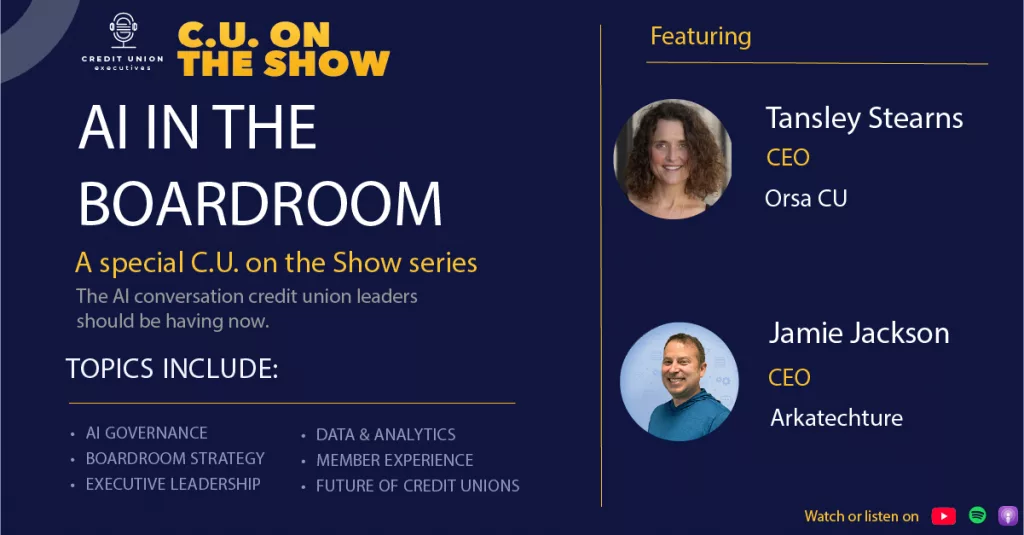
Doug English: , [00:00:00] Jamie Jackson and Tansley Stearns, welcome to CU on the show. I’m delighted to meet both of you, and to hear about what you have been doing together at Orsa Credit Union, uh, a- and that, uh, may help the rest of the credit union movement. So as always, I like to know a little bit about how did you get started working in this, uh, wonderful movement.
Uh, let’s start with you, uh, Jamie. How did you get started working in the credit union movement?
Jamie Jackson: So started Arkatechture as a boutique data consultancy, uh, shop. In my prior life, I’d worked for large enterprise, uh, deploying enterprise analytics solutions, but predominantly in the financial services, i.e.,
the big banking world. Um, and, uh, being part of that big monolithic machine where you needed acts of Congress to change and guide project plans of some of the organizations I was working with, really kind of was lacking kind of that, uh, that feedback loop of having impact for the customers at that point.
I was the guy that was going to my local branches [00:01:00] to talk to the tellers to kind of find how I could better serve them, um, with the analytics solutions that we’re deploying. So I actually stumbled into, uh, the credit union space by St. Mary’s Bank, which was very confusing to me because it was the nation’s first credit union, and they have bank in the name, so I did not know all the history that went into it.
And it was really just to help- That’ll mess you up. Yeah, it, it did mess me up. It was very confusing, and it was to help them go through a core conversion and really get from point A to point B. And we stumbled into leveraging data to kind of as b- for their BI and, and strategic value of their organization.
So it wasn’t an intentional analytics and business intelligence journey, but it quickly turned into one. But once I got through the whole, “You don’t care about profitability. You don’t care about kind of revenue. You, you’re supporting 80 products, and 40 of them aren’t necessarily the right fit,” and started to understand why that mattered to them and understand the Kool-Aid of, you know, serving the community and serving the members, like, I fell in love.
And it was the sort of situation where having kind of the mission alignment to helping the [00:02:00] community, but then the use and adoption of data for this industry, they’ve been so starved of it and not available to them. So then that, those acts of Congress and all the red tape in the big organizations, the credit union was making business decision changes and adjustments on a day-to-day basis, which the dork in me, the dopamine drip in my brain as far as, “Oh, there’s, there’s usage-
of this that’s having tremendous impact.” So, um, they say it all the time, right? The, the drinking the Kool-Aid, and I’m drinking the Kool-Aid very heavily now. Um, and we service predominantly the credit union space. Our product Archlytics is built for, you know, credit unions, and we are a CUSO as well. So, uh, we went all in on the, the industry and haven’t turned back since.
So that was my foray into, um, the introduction. A very confusing one at first, but once you know, you know.
Doug English: Wow. A great start. Now, Tansley, I don’t know that you need any introduction in the credit union movement, but maybe just how did, how’d you get started? How did you end up in this place?
We’re very glad you’re here.
Tansley Stearns: Oh, well, thank you so much, and thank you for the opportunity to connect today. My story is very [00:03:00] similar to many. I stumbled into credit unions. One of my impossible dreams is to make sure that we change that trajectory, and that the next generation is all really enthusiastic to be working for a credit union someday, and I think that that’s something that we need to elevate.
And I graduated from U of M. I was looking for jobs in both social work and marketing, because at 21, who knows what they wanna do with their life? And I found a small credit union that was hiring a marketing specialist, and very quickly fell in love, and also very quickly had this dream to become a CEO.
So, my career took me all over this great country. My mentors gave me really good guidance about the fact that if I started in marketing, it was gonna be tougher to convince a board that I could earn this seat. And so I’ve worn a lot of different hats at many institutions, and just feel really passionately that cooperative finance is one of the answers to solving so many challenges, and to making [00:04:00] life as meaningful as it can be for human beings.
Doug English: Mm-hmm. Wow. A huge statement, as you’re famous for. Very good. Well, we’re gonna try to weave back and forth between data, and your work in data and analytics, and the things that you guys have done together, uh, and into strategy, and kinda see if we can kind of see how these things work together. Tansy. How do you, uh, how do your data analytics initiatives, uh, tie into the credit union’s mission and values?
Tansley Stearns: One, I think it’s critically important to understand our impact, and the only way that we can understand our impact is to measure that. A really good example of this, it’s very tangible, is our board describes our vision as our ends. They think about the difference that we can make in the world and have described it very succinctly.
And as they’ve done that, my expectation is that we interpret that and [00:05:00] share back how we’ll measure those efforts. And what we’ve done is we’ve created a website where we host a readily updated version of those measures and how they come together, and all of that is very data-driven. And it’s certainly everything from the typical measures that you might think about for a credit union, return on assets and the financial health of the organization, all the way to things like how are we making a difference for first-time homebuyers?
How are we making a difference for women and owning their home for the first time? And so the impact measures that we have really complement the financial measures, and I think it’s a great example of how we ensure that the organization is thriving, and when we do, that that means that human beings are thriving as well.
Doug English: The impact measures [00:06:00] complement the financial members, right? That’s what you said, the i- the impact measures complement the financial measures, which is a really interesting, uh, way, a better way, I think, of looking at it than the impact measures are a cost center. Can, can you, uh, go any further, uh, in that, Tansley?
Tansley Stearns: Well, the other thing that I would say is that it is about the organization understanding itself and understanding our performance. More importantly, I think when done well, and we’ve still got a journey to take here, is it’s a way for human beings to understand why Orsa matters to them. You know, if, if we can be talking about the number of people that own their home because of Orsa, if we can be talking about how much money we’re saving people, if we can really translate the difference we make in people’s lives through data, that’s a reason for somebody to shift.
You know, one of the challenges I think credit unions face is that [00:07:00] for the average American, we get lumped in with financial institutions, and quite frankly, the brand of financial institutions is not particularly good. You know, I had the opportunity during my time at Filene Research Institute to do a lot of studying with consumers.
And I remember being in one credit union where we were talking about a situation that happened with a relatively large bank, and the, the question we had was, gosh, you know, will you be changing, for those that were using that bank at the time. And the overwhelming response was something like, “Eh, I don’t really expect it to be much better, and I’m not sure it would be at any other financial institution.”
And so when we talk about our purpose as an organization, that sounds great. I’m enthusiastic about it. We have work to do to make sure that everyday Americans understand the impact that we’ll have on their lives, because changing is hard, even [00:08:00] for those of us who’ve really invested in making it easy.
You’ve got the obstacle of people thinking, “Ugh, you know, I’ve got these automated payments. I don’t wanna have a new piece of plastic. I don’t want a new app.” If we can describe our impact and the meaning it truly can provide in people’s lives, that’s a reason for them to shift
Doug English: Outstanding. All right.
So let, let’s go over to you, Jamie. How do you help with capturing that for, uh, credit unions?
Jamie Jackson: I think that’s what’s unique about kinda the credit union space, is that, like, even the term, like, deep personalization, it’s like, it’s actually better advocacy.
So it’s not, “How do we sell them products?” It’s, “How do we advocate on the financial wellness of this member,” right? So it’s like a completely different mind shift as far as, hey, how do you just sell in more, and, and how do you maximize the return versus how do you get the most value of that for the member directly themselves?
And that’s, like, the part that’s intoxicating [00:09:00] about working with this space and why … I mean, even the concept of member-owned, like, why isn’t that more in the forefront? Why is that pushed back to the back end, right? That means more and more in this day and age. So I think that the data challenge has been, you know, the
If you look at the digital transformation that occurred over the last four to five years, which was required and necessary, and now you talk about what AI’s gonna do to push that even further, it just created more bespoke, siloed pieces of information. So then, which created a technology problem, which now your data’s in 45 different silos, as opposed to the two to three that it was before.
And so I think the course of the last five years, too, has also, it’s, it’s removed the business aspect of a, a data initiative, and it turned it into just a technology project and a technology problem, because there is an API sitting in between. And I think that was, like, the biggest miss, was because it took away the decision-making from the decision-makers, right, and it put it in the hands of just pure technology.
So I think what we’re really doing is bringing it back to enable this [00:10:00] advocating for their members by getting all the data in one location. And this is gonna continue to be a challenge with more and more innovation that’s occurring, but the key piece is getting the right information to the right person at the right time in the right format, um, to have that advocacy.
Uh, so that’s where, you know, the, the energy behind that is for advocating for someone as opposed to selling them something, and I think that’s the part that really ignites our passion here at Arkatechture, um, and what makes it worthwhile to push more and more, um, working with our credit union customers and partners
Doug English: So, so the, the, how did, how does data analytics and AI help to, to enable us?
To, the, again, what Tansley said is the difference in people’s lives through data. How do you go about that? Like, where, what is the process? Like, what do you gotta identify first? Where does the strategy need to come from? How does it get started at a credit union that has not yet started it? [00:11:00]
Jamie Jackson: Yeah. And why I anchor down on that advocacy perspective, ’cause this can get creepy really quick as well, right?
Where, hey, your information is in many different places, in the marketing automation, in the CRM, in a chat bot, in an accounting platform, in your core platform, in your originations platform, hopefully not in your collections and recoveries kind of platform. But all that information’s in different places, right?
So understanding me as a member at my credit union, like, you need to have all that information. If that experience isn’t someone calls in the call center, walks into a branch, and they have to say, “Oh, the Internet’s very slow today,” um, meanwhile, they’re just pulling up the 14 different screens on their system to have that single pane and view of things.
Mm. So I always say just get it all in one place first. That’s table stakes, right? Getting into one location of all your various systems, and then that single source of truth where you make the Jamie Jackson member record, um, and Tansley, like, I, I don’t know if this one resonates with you, but, like, the definition of an active member, usually there’s [00:12:00] like five different definitions at a credit union.
Right? So sometimes it’s just getting everyone at the table to finally agree on what that governed set of information is and what that definition is across the board, and then you start to build your, your business intelligence, your reporting. And if you imagine, like, if we’re pushing the boundaries of more automation and more underwriting and more decisioning, garbage in, garbage out on the AI that you’re looking to use.
So these are two foundational steps. Get it in one place, and then see and trust it and believe in it as an organization. If you don’t do those first two steps, like, you’re just running to something that has the buzzword and doesn’t have the, the meaning behind it. So, um, that’s step one and step two in, in keeping it simple.
But sometimes that s- active member definition conversation can be a tough one, where you have some pretty heated debates at the credit union around what their opinions are of that
Doug English: Okay, Tansley did you have anything to a- add to that? Especially, I would love to hear about the strategy discussions that led to where you go into [00:13:00] capturing the single source of truth and the one, um, one definition of an active member.
Maybe. Maybe you get to one definition. Maybe that’s a work in process.
Tansley Stearns: No, it’s critical, and it isn’t something that’s uniform. I think what Jamie points to is- Yeah … the challenge, which is, I’ve worked at several different credit unions. All of them had different points of view on that, and I’d love it if we, as credit unions, were all aligned on it because it makes comparing credit unions even more challenging.
Not that we need- Yeah … to compare ourselves to one another. And I do think it’s one of those moments around data that is, is not as seamless as what it could possibly be. For us at Orsa, we are really committed to, again, creating impact, uh, through cooperative finance. When we were unpacking our priorities, one of them had to be, how do we have better information?
The way I like to think about it [00:14:00] is really the headlights of a car. If we’re driving down this road serving Michiganders, and it’s a thunderstorm, and now it’s gotten really cold, and it’s hailing, and my windshield wipers don’t work, and I’m not using my headlights, it’s really, really difficult to know what’s going to happen, and it can even be a little bit terrifying.
We need data to have those headlights and to have the windshield wipers work really well, and that data guides decision-making. And it also really helps us to understand, how is the strategy working? You know, we have a pillar of our strategy that is to be a best friend to women and those who love them. I have to be able to measure that and understand that, and also understand the needs of the members that we’re serving.
I think it’s critically important to have some signals around times where we might be at risk of losing members, and, you know, all of those things can come out of data. And I [00:15:00] really think Jamie’s point is an interesting one. During my time at Filene, we had several white papers about data. Of course, we were talking about big data at the time.
And I remember distinctly from the time that we were first doing that very first white paper to a couple years later, when I was first in boardrooms, board members were like, “No, this is super creepy. We don’t wanna do that. This isn’t right. Our members aren’t gonna like this.” W- trust is everything. Two, trust is everything, and they’re not gonna trust us if we don’t use it, because all of us normalized-
Doug English: Mm-hmm
Tansley Stearns: this data being used, and so it’s almost a little strange if a credit union isn’t. You wonder, gosh, is there a sophistication issue? What’s going on? Why wouldn’t they be using it?
Doug English: Mm-hmm.
Tansley Stearns: So, you know, I, I think it’s incumbent upon all of us to, to understand, first of all, as we began, you know, what’s the strategy?
What is it we’re trying to accomplish? And how do we understand through data where [00:16:00] we are today, where we need to get to, and how we’re progressing over time?
Jamie Jackson: Thanks for butting that for me, Tans. I, I realized I just left it at it could be creepy real quick, and didn’t say why it’s creepy- Yeah … um, potentially because of all that tracking that is- Yeah
happening out there. But it’s like, you know, tying it to the value that the member’s getting. It’s that sort of thing.
Tansley Stearns: Yeah, that’s it. Appreciate that. Well, the example I often give, yeah, I, I have this very bad habit. I- … love a Diet Coke, maybe more than one, and you know, I would love my credit union to say, you know, “Gosh, Tansy, you’re spending X amount on Diet Coke.
You’re spending X amount on this.” “Here’s a, here’s a slight adjustment you might make, right? And this is what it would take for you to do that.” I, I think those nudges are really, really useful. I’m very used to getting those kinds of nudges as a- Yeah … consumer, and if my financial institution is proactively helping me to make better financial decisions, that’s going to improve my loyalty and trust, I think, [00:17:00] in the long term.
And I’m very willing to hear that because I know my financial institution has that data.
Doug English: Yes, but are they ready to use it, right? That’s, that’s the question, is are they ready to use it? So what have you guys, uh, been working on together? What have your two, what have the credit union and Arkatechture been working on?
Tell me, tell us a little bit about that.
Tansley Stearns: So we have, as I mentioned, a, a really strong and focused strategy, and as part of that we wanted to improve that single source of truth, really wanted to improve getting information that helps us to make stronger business decisions.
And as we were thinking about how we got that done, really felt as though we needed a partner in bringing that to life, and that brought us to Arkatechture after having looked at a lot of different choices, felt like there was values alignment. You know, for us at Orsa, regardless of the topic, we depend, [00:18:00] as smaller financial institutions, on partners to bring a lot of our work to life.
And my thesis, uh, that our board and senior leadership team share is that we don’t have vendors, we have partners, and so that begins with values alignment, and really found that in Arkatechture. And this journey’s not an easy one, for all the reasons that we’ve talked about. You know, getting to- Mm-hmm, mm-hmm
data definitions that all of us are aligned around, understanding how that, all of the systems are gonna plug in together. You know, I think both of you mentioned we, again, as credit unions, depend on lots of different partners to bring our work to life. So we have our core system, we have our mobile banking system, we have lending systems.
All of those have to come together in order for that data picture to be as crystal clear as it can be. So this is a big, big project for us, and I believe one of the more important ones, because it’s going to ensure that we have the right information to have that really clear [00:19:00] view as we’re driving through a storm, and get to a sunnier day.
And also, that we can digest that information and share it back so that Michiganders understand the impact that Orsa makes.
Doug English: The metaphors, the single source of truth, the single pane of glass, uh, the, the, the one place where we can point our systems to be able to understand the questions and then bring it back to how it makes a difference in people’s lives through that data, right?
That’s where, that’s where you’re headed, uh, as, as I understand it. How long is that journey going to take? Are you already able to operate on the single source of truth, or are you in process of making it?
Tansley Stearns: No, we’re in process right now.
Mm-hmm. And I think my opinion is that this is work that is not ever done. You know- Yeah, yeah … I think our ability to continue to hone what we understand. My hope, you know, we have several values at Orsa that are very important to us. One of those is [00:20:00] curiosity, and what I believe will happen is that as we stand up Arkatechtures, we have more information, as we have that single source of truth and we’re able to garner more insights that will drive better decision-making, we’re gonna be more and more curious, and that curiosity will drive bigger, better questions.
And the more of those insights that continue to grow, I think the more questions will come, and that’s thrilling, and it’s why having the right partner on this journey is so important.
Jamie Jackson: And that piece that she just said is, is so critical ’cause I think, I mean, we can talk about the organization Orsa and kind of my experience of going there early morning and just feeling the contagious kind of cheering and laughter, but that curiosity and, and the word investigative, like, I think oftentimes folks think that the- they’re gonna just validate what they know with the data.
And so they kind of go in the direction that way, and then data might start telling them something different, like, “Oh, well, the data’s wrong.” And so there’s that kind of moment of, “Well, where do [00:21:00] we go from here?” And that’s organiz- some organizations say they wanna be data-driven, others actually back it up.
And I think that, that part of the curiosity is what’s so exciting about getting them going on their journey, and it is a journey. This is never-ending. Um, I mean, I’m old enough to make fun of … Remember when chatbots were something you made fun of pre-pandemic? Mm. And then the pandemic happened, and all of a sudden it was, like, a critical part of business and engagement of our membership.
Well, that’s another data source that’s now flowing in, and you wouldn’t think that was important information. But those interactions, you know, they used to be just purely social media as far as how people are consuming and engaging with you. Um, so there’s many different kind of pieces that come into this, and it’s an evolving, iterating perspective of the journey, and you should just be getting better and better as you go.
So, um, th- it’s really inspiring and kind of exciting when you hear somebody say that because that’s a true sign of them wanting to listen to the data and then make decisions in various ways that might be different than where they were beforehand, so.
Doug English: Yeah. How did you identify the, the, the gap, the need to do [00:22:00] this?
Uh, you know, the, the mission that you’ve described very, you know, you wanna be able to quantify the impact that you’re making in people’s lives. Do you r- recall what, what caused you to recognize that you didn’t have the data in the way that you needed it?
Tansley Stearns: Yeah, you know, when I got here in June of 2022 and looked around at what we had and asked a lot of questions from our team about some of their bigger challenges, this was certainly one of them.
And, and we wanted to make sure that we had the right partner in bringing that to life. There are lots of good choices. And, like I said, for us, it is not only about technology, it is really about values alignment and finding those partners that share in our values, a- again, in this case, really grounded in curiosity is, is a very big deal.
So it’s been an important part of many things that we’re doing to make sure that Orsa is ready for the next [00:23:00] 75 years as we, in this year, celebrate our 75th anniversary.
Doug English: So when you think back to the, the, uh, the values that, that you, you, you have alignment between the two companies from those values and you’re trying to quantify the impact you make on members’ lives, um, how do you think you’ll see that first?
Where, where do you think it’ll, it’ll show up first? Or is it too early to know?
Tansley Stearns: Yeah, you know, I, I guess if I were better at predicting the future, I’d probably have a vastly different life. And- Ah,
Doug English: yes.
Tansley Stearns: You know, I, I do also believe that what is gonna be most powerful about this partnership is when we start to have those light bulb moments, and I think it will be a flywheel in terms of gaining insights, growing more curiosity, gaining more insights, being able to share those back.
You know, I, I think that credit unions have always had a bit of a gap in storytelling, [00:24:00] and we’re super invested in elevating that, and I do think that data is a big part of doing a, an even stronger job of storytelling to members because I think we can quantify impact, which is a reason to act. You know, th- there, there’s a sort of top of the funnel where we wanna be really bringing people in, helping them to see the possibility within credit unions.
Where it gets really personal, I think, is when you can see, gosh, we save people this much money. We enable these kinds of dreams to come true. We ensured that these darker moments were a bit lighter, and I think the data’s gonna allow us to do just that.
Jamie Jackson: And those, those core principle kinda questions and drive, like- Organizations that are seeking to continue to be the credit union versus just become like a bank.
I mean, there are some organizations that are just trying to act more like a bank. Let’s, g- growth for growth’s sake. Um, let’s scale up and be larger for, for what reason? N- not the [00:25:00] purpose behind it. But the kinda trick with what Tamsin just said is that personalization, that understanding, that requires you to have all that information, and then how are you deploying this to help your membership?
Um, we had one credit union, uh, a customer of ours that they ran their… Well, first they came into the perspective of, “We wanna have the next best product to put in front of every single one of our members.” And then we had the conversation like, “No, you don’t.” Because if that actually happened and it was successful, you’d have an onslaught of incoming inbound to you, and you would not be able to handle this.
You’d not be equipped to respond, and then everyone would be even more angry at you for not doing anything after you got them to the table. Um, and then they ran, like, it was a, a credit card campaign for, um, 20 members. They had something like 15 out of those 20 converted, and then they built out the marketing kinda memory and muscle, and then they got wider and wider and wider.
But they had a specific segment of their membership that they were going after, and I mean, you know, I, I am a person of mission as well, and everything Tamsin’s kinda talked about where Orsa aligns is passion areas of myself. Uh, I have [00:26:00] two little girls, uh, first before I had the son, and man, boys are different than girls when you’re raising them, I will tell you that, and how humbling that is as an experience.
So, um, when you’re kind of driven by the mission, you need certain data assets, but then you start deploying it much faster than a pure revenue generator. So I’m excited to kinda watch where Orsa goes. Um, and this doesn’t have to be, this isn’t a year, multi-year kind of journey to get there. This is the sorta thing they’ll be up in, in motion with this stuff in the, in the months to come, um, and then evolving and iterating from there.
So, uh, I’m obviously a big fan if you couldn’t tell already. But, um, I think passion drives success, and their organization is, is full of passion for sure.
Doug English: You both described a mission-driven organization from one that masks itself as one, as one that just markets itself as a mission-driven organization.
H- how do you see that difference, uh, in the movement, or how do, how do you see that difference anywhere? [00:27:00]
Tansley Stearns: You know, I, I- To me, of course Yeah, yeah 100% I, I think it’s really about, again, it, it does come back to data. You know? It, it’s the difference between words and words married with actions that lead to different results, you know?
I always want us to be very, very thoughtful about what it is that we’re saying. That’s not because I was an English major or because I started my career in marketing, it’s because words are cheap if they aren’t backed up by the things that we’re doing, and how we activate those things then translates to change in people’s lives, and being able to share that more broadly should allow us to manifest more change.
So it, it is certainly about telling the story that matters deeply, and we should only be telling that story and shouting it from the rooftops when we can back up that story with our actions
Doug English: In other recordings that I’ve done, [00:28:00] one of the key, um, takeaways that I’ve had is how the credit un- industry has trust, has more trust, uh, particularly from younger members than other financial institutions might have.
And as you dig into the clarity of the single source of truth, the data, how do you think that might, um, resonate with the younger generation different than the older? You mean, you know, y- y- Jamie, you mentioned that, uh, it was a little bit scary or some similar term to kind of getting all this information together, and I think folks of, with some age, um, as some of us like me have, uh, can have that feeling of y- y- you know, the, the big brother experience.
You know too much. You’re leaning, you’re leaning in too much. And then the younger folks, of course, want it to be completely custom to their experience, ’cause that is the Amazoning of the customer. Uh, you know, so h- do you have a expectation for how that might be [00:29:00] different through the member age spectrum?
Jamie Jackson: Yeah, and I mean, I think … and they’re entitled to. Like, entitled’s like a dangerous word to use, but- … I mean, you know, I, I once considered myself in the younger generation. I am not by any means no longer. But, you know, there are folks that-
Doug English: It was good when it was there.
Jamie Jackson: That’s right. But I mean, their financial literacy that they’re getting is through TikTok videos.
Like, they’re learning how to do finance through TikTok. So they’re consuming information. You started talking at the, the top of the hour, um, about YouTube as kind of the means and method. Uh, there are just two movies, h- two horror movies that resonated with, uh, the younger crowd and dominated kinda the box office, right?
So, um, they’re used to kinda banking in a different manner. But they have not lost track. They, they want personalized guidance, not just, you know, generic products, right? They’re not just … They don’t know what they need, but they need something that aligns to who they are and where they’re at with life. And the trust and transparency aspect of things, I think that’s more resonant with this younger generation than ever before.
Like, I think there is a, a level [00:30:00] of understanding that, you know, big corporations aren’t necessarily good. Um, I didn’t grow up in that kind of generation. We had to learn that ourselves going through. And then the digital experience, they want that first, but they want the human backup there too, right? The- Mm-hmm
the person in the loop, and that’s, you know, credit unions are a huge, um, focus of, of that as the human backup as well. So I think, you know, this all just comes down to the data, um, but then the literacy and the education aspect of things, they’re, they’re not necessarily getting that in a productive manner.
Or, I mean, I’ve seen some credit union TikTok videos that are pretty great as far as how they are teaching the financial literacy. So, um, but the removal of friction, the instantaneous kind of need of kinda something in place, everything’s in that direction, and- The AI is leveling that playing field. Um, right now the big banks haven’t figured out how to harness it as, as well as they should.
So now there’s an opportunity to kind of creep into that, and if the technology piece is just set aside, credit unions are gonna destroy banks ’cause they have historically, and they’ll continue to do so. So I think [00:31:00] it’s a really exciting time, um, and I think it’s a good challenge from the younger crowd to the credit unions to kind of…
the velocity to improve and the s- speed to getting something out front of them. But the education piece and the trust piece I still think is critical for this generation
Doug English: Tansley, anything you’d like to add? Or I have another question if you’re-
Tansley Stearns: Yeah, you know, I, the, the only thing I would add is I think the responsibility for us is to make sure that we’re meeting the next generation where they are.
You know, we are super aligned on purpose. It does have to be easy, and the way that we deliver things like financial literacy has to be relevant. You know, one of the reasons I was excited to come to Orsa, we have 50 student-run credit unions across the state of Michigan. And when my daughter, Mackenzie, was in the sixth grade during our first year here, and I asked her what it was like when we were in her school- She looked down at her feet, and where that’s [00:32:00] led us is to being the very first financial institution on Roblox.
Now, when I watch my daughter play Roblox, I don’t understand anything about it. Me either. She’s driving a car into our branch. She’s picking up litter in our branch. Nothing about it makes any sense to me, and that’s precisely why we ought to be there, because I am about to turn 50 years old, and if we want to provide financial literacy to the next generation, we have to meet them where they are.
And, and I think Jamie’s absolutely right. There is a requirement of technology forward, married with the ability to connect interpersonally, because they are desirous of both.
Jamie Jackson: Tansley, you … I can’t let my kids listen to this podcast now because I’ve been like, “No Roblox. No Roblox. Minecraft, okay, but Roblox…”
And here you are being the cooler mom. So kids, if you’re listening, I’m
Tansley Stearns: sorry. Not sure about cooler. I, it is really fun, though, and the co-creation with students is just [00:33:00] magnificent, to be able to understand from their lens. And they’ve given us some tough feedback. One of my board members, his son was testing it for us, and didn’t like some of the things that we were doing, thought that they could be better, and that’s, that’s the way we’ll get to relevancy with the next generation, is we’ve gotta listen.
Absolutely. And if we marry that listening with our subject matter expertise, we really have a recipe for something special.
Jamie Jackson: Absolutely.
Doug English: Hmm. I, I, I wanna ask a, a, a similar wrap-up question to each of you. So, uh, Jamie, uh, what, I’d like you to tell me, what does it take to build the data foundation that enables this i- innovation a- as well as the, the impact, uh, on the member that Tansley has talked about?
And then Tansley, if you could a- the same question, but from a vision, from a mission standpoint, what does it take to end up where you are? And if, uh, so another credit union’s listening, uh, and they are not yet [00:34:00] progressing down the single source of truth path, if, if you will, how might they th- um, f- examine their strategy and, uh, and re-look at it?
If you would, please.
Jamie Jackson: Yeah, so I mean, uh, our pla- platform that we built, our politics, I mean, I always make this comment. It could be stood up in days, but that will never happen because some of the pieces of this are the cultural aspect, the adoption, and getting the trust. I mean, we could go, “Here you go, Ursa.”
Here it is right out of the box, and well, I need to know more. And they need to see it. They need to define it. They need to customize it to their liking. Each credit union is unique. I mean, uh, m- m- sometimes they think that too much, and there are a lot of similarities that could be consolidated, and that, active members, I, I agree with you there, Tamsley, as well.
Um, so we typically will deploy in, you know, two to six months working with full training, like production acceptance, walking through where the whole organization. What I love about Orsa too is it’s not just, you know, a certain set of people using reports and content. It’s their whole [00:35:00] organization. You, you see her leadership team and her management team, they’re all passionate about, passionate about this.
So we typically have credit unions up in, you know, anywhere from two to six months. Like I said, it could take days. It’ll never do that. But then it’s, you know, where do you kinda go from here? And that’s that kind of partnership. We don’t build a black box where they can’t customize. We are co-developing with them, so Orsa could shift and shape as far as what their data makeup looks like and what their team looks like, and we’ll be there to support them to get them building or us being the builders for them.
So, um, it’s a repeatable thing that we’ve had success for over 60 different kind of, um, credit unions. And, uh, the 100% success rate is something we are proud of and will continue to measure ourselves against to make sure, uh, we enable them to make all the impact that they wanna have via data-driven decisions.
Doug English: Yeah, and, and I believe you, uh, said earlier that you’re a CUSO, uh, so a credit union own- owned is always nice to see.
Jamie Jackson: Yep, that’s right. And we, we became a CUSO after we already had a business and a product, so we did not take credit union money to then [00:36:00] build an idea that we had. So that was, like to have that clear differentiation as well.
So, uh-
Doug English: Very good. Tansley, over to you for the vision.
Tansley Stearns: You know, I think it really is about culture and people. You know, I, I think my observation i- in many organizations is that where data strategy falls apart is in the habits and mistrust, right? We get used to having run a report every month, every day, every week, at whatever cadence, and relying on that, and, and owning that.
And a strategy like this, especially when we wanna get to a single source of truth, really requires everyone come together and be willing to let go of some old habits. And I once had a leader tell me, “You have to let go to grow.” I think that’s absolutely accurate in this case. And also, [00:37:00] really connecting it to the vision, right?
We are investing in this data strategy because we know it’s going to allow us to better understand our members, to create more impact, to share that impact, meaning that we will be able to create more positive change for more people across the great state of Michigan. It begins with strategy, and it ends with strategy, and it’s connected all the way in between.
Doug English: And the Diet Coke moments of the future will be created from that single source of truth.
Tansley Stearns: Awesome.
Jamie Jackson: Did you notice, though, that Tansley didn’t have an option of, like, “Hey, you should stop drinking Diet Coke altogether.” Oh, no. That was not in her option list.
Tansley Stearns: No. No, that is not on my option list.
Jamie Jackson: That’s where I thought you were going at first, and I’m like, “Oh, nope, she’s gonna continue on,” so.
Tansley Stearns: No.
Doug English: I think she was offering awareness as the, as the, as the single step in the … Just awareness. The Diet Coke as a percentage of your monthly spending.
Tansley Stearns: That’s right. That’s right. [00:38:00]
Doug English: Well, thank you so much for taking the time for the work you do for the members of Orsa and the, the greater members of the credit union movement.
Uh, I, I love the, the good stuff that we do in this industry. Uh, and if our listeners want to learn more about the work you’re doing together, uh, uh, obviously, um, uh, Orsa Credit Union is a, an easy, uh, entity to find. Arkatechture has a little bit of interesting spelling. Jamie, tell us a little bit about how they can find your information if they’d like to.
Jamie Jackson: Oh, you mean it’s the right way to spell Arkatechture. Yeah, no, uh, you’re right. Now, if you look at our name long enough- … you’ll just see that being the correct way. Uh, but you should do a quick Google search, uh, Arkatechture’s spelled a little bit differently, but, um, very much, uh, out there on the internet.
Uh, have our social media as well, but, um, A-R-K-A-T-E-C-H-T-U-R-E.com. Again, you won’t be able to see it the, the wrong way after seeing it this way, so.
Doug English: Yeah. Very good. Very good. The single source of Arkatechture. There you are.
Jamie Jackson: Yes, there we go. Yes.
Doug English: Thanks so much [00:39:00] to both of you.
Tansley Stearns: Thank you. Thank
Jamie Jackson: you, Doug.
Disclaimer: This content is for educational and informational purposes only and is based on a discussion with third-party participants. It should not be construed as investment, legal, cybersecurity, privacy, compliance, data-governance, or operational advice. Credit unions and other organizations should evaluate data collection, artificial intelligence, personalization, and related technologies against their own policies, regulatory obligations, information-security requirements, vendor due-diligence standards, and legal counsel guidance. Any references to technology, workflows, or potential outcomes are illustrative and may not be indicative of actual results. ACT Advisors does not guarantee any specific operational, governance, member-service, or financial outcomes. Results will vary based on each institution’s systems, processes, controls, policies, data quality, and implementation. The guests featured in this discussion are not clients of ACT Advisors and were not compensated for their participation. Any views expressed are their own and do not constitute a recommendation or endorsement of ACT Advisors or its services. References to third-party organizations, platforms, or resources are for identification and discussion purposes only and do not imply endorsement, sponsorship, affiliation, or approval by those third parties.