How Tokenizing Loan Participations Could Influence Credit Union Balance Sheets
Loan participations have long been one of the most important—but often least visible—tools credit unions use to manage their balance sheets. Despite their strategic value, the current process can be slow, manual, and difficult to access for many institutions.
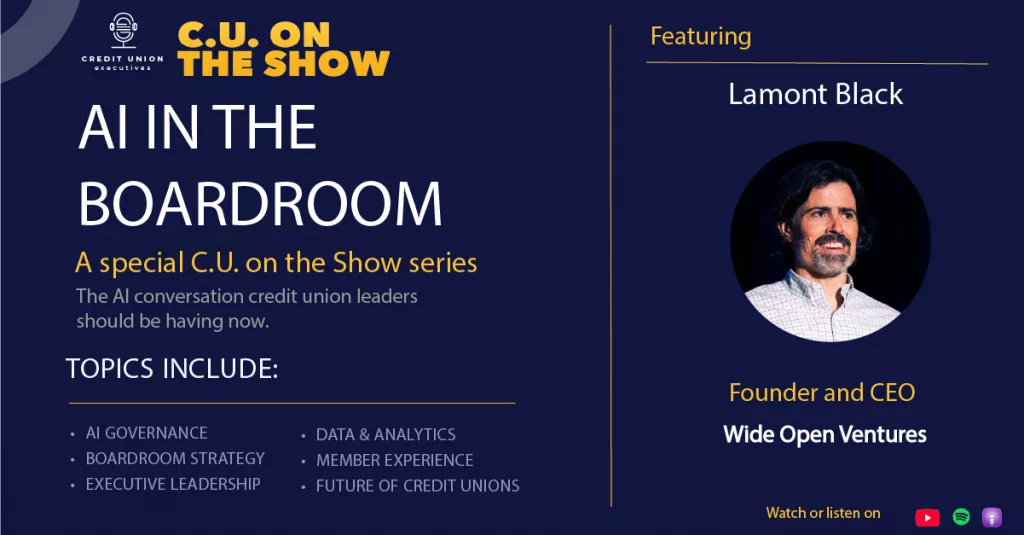
In this episode of C.U. On The Show, Doug English speaks with Randy Stolp, co-founder of Loan NFT, and Lamont Black, professor at DePaul University and founder of Wide Open Ventures. Together, they discuss how a new platform concept aims to modernize loan participations through blockchain-based tokenization and AI-driven analytics.
Their goal is straightforward but ambitious: to explore the development of a more transparent and efficient secondary market where credit unions may be able to buy and sell loan participations with greater speed and insight.
If successful, innovations like this could have meaningful implications for the industry. Platforms such as Loan NFT are intended to provide credit unions with additional tools that could help manage liquidity, support lending capacity, and strengthen collaboration within the cooperative financial ecosystem.
Why Loan Participations Matter More Than Many Realize
Loan participations are commonly used by CFOs and lending leaders to help manage liquidity, earnings, and concentration risk. When one credit union originates more loans than it wants to hold on its balance sheet, it can sell portions of those loans to other institutions.
This process can help credit unions:
- Manage liquidity positions
• Reduce concentration risk
• Continue originating loans for members
• Maintain overall balance sheet health
However, the process today can be cumbersome. Transactions often involve brokers, spreadsheets, emails, and extended negotiation periods.
According to Stolp, that complexity means the tool may be underutilized across the industry.
By streamlining the process with modern technology, more credit unions could potentially use loan participations as a strategic balance sheet management tool rather than only occasionally.
How Blockchain Could Potentially Improve Loan Participation Transparency and Efficiency
At the center of the Loan NFT platform concept is blockchain technology, which is designed to enable secure information sharing between marketplace participants.
Instead of relying on multiple intermediaries, the platform is designed to create a shared ledger where buyers and sellers could interact more directly. Each loan may be represented as a digital token, enabling efficient tracking and verification of loan data.
Black explains the concept simply: one token represents one loan.
The blockchain ledger records ownership and transaction history, while the underlying loan data remains securely stored off-chain. This structure is intended to allow credit unions to maintain privacy while still benefiting from improved transparency.
In practical terms, the system is intended to provide several potential improvements, including:
- Faster transaction processes
• Lower transaction costs
• Improved transparency
• Reduced reliance on intermediaries
If successful, these changes could narrow the “bid-ask spread” between buyers and sellers, potentially making the market more efficient.
While these concepts are promising, they are still developing and involve risks, including adoption challenges, regulatory uncertainty, and execution risk.
How AI Could Help Credit Unions Evaluate Loan Pools
Beyond blockchain infrastructure, the platform concept also incorporates AI-driven analytics.
Credit unions preparing to sell loan pools sometimes face challenges when determining appropriate pricing. Without broad market visibility, it can be difficult to evaluate whether a pool is priced competitively.
The Loan NFT platform aims to address this by allowing users to describe a loan pool in natural language. The system could then analyze comparable pools and generate pricing insights designed to assist users in evaluating potential transactions.
This type of analysis may provide credit union leaders with additional data points when evaluating participation opportunities.
The combination of AI for analytics and blockchain for transaction infrastructure illustrates how emerging technologies could potentially support the credit union ecosystem.
How a Cooperative Marketplace Could Expand Lending Capacity
The longer-term vision discussed by Stolp and Black extends beyond technology itself.
They believe that a more efficient loan participation marketplace could improve how credit unions allocate capital across the industry.
At times, credit unions slow lending activity when liquidity or capital constraints arise—even when member demand remains strong. With a more efficient secondary market, those loans could potentially be sold to other credit unions that have the capacity to hold them.
That dynamic could allow credit unions to continue serving members while balancing liquidity and risk considerations.
In other words, a more efficient marketplace could support a more collaborative approach to balance sheet management across the credit union system.
How Loan NFT Plans to Bring the Platform to Market
The team is currently seeking approximately $2 million in seed funding to support development and bring the platform to market.
Unlike many fintech funding rounds, the initiative is structured as a Credit Union Service Organization (CUSO), which could allow participating credit unions to become early investors.
The goal is to include approximately 15 to 20 partner institutions that may help shape the platform’s development through an advisory committee.
Initial functionality is expected to focus on auto loan pools, one of the most standardized and commonly traded loan products. Over time, the platform may expand into additional loan categories such as mortgages, commercial lending, and other credit products.
The team hopes to conduct an initial live transaction within the first half of the year.
ACT Advisors is not involved in any offering, does not facilitate investments in Loan NFT, and is not soliciting interest in any securities.
Watch the Full Episode Today
If you’re interested in the future of credit union technology, cooperative finance, and innovative lending infrastructure, this episode offers an in-depth discussion.
Tune in to hear a conversation about how Loan NFT aims to modernize one of the tools used in credit union balance sheet management—and what that could mean for the future of the movement.
Prefer to listen audio only? Listen on Spotify!
Episode Links
Audio Transcription
Doug English: All right. Welcome to CU on the show. I’m delighted to see Randy. Uh, I haven’t seen, uh, Randy since a conference couple years ago.
Glad to to see you from a loan NFT. I was gonna try to say your last name, but I was pretty sure I was gonna mess it up so I didn’t try. Oh, you’ve gotten and a lot black from, uh, filing and wide open ventures. Welcome, delighted to have you on the podcast Today, we are gonna talk about some very interesting, uh, things that you both are up to.
So let’s, uh, start by, I, I always like to know how did you get started in working with credit unions? What is your connection to this great movement and what are you working on today?
Randy Stolp: Yeah. Cool. I’ll start, Doug. Uh, 25 years in the credit union movement now, uh, three credit unions. Uh, and this’ll be my third qso, uh, I loan NFT.
Uh, you know, I started off running call centers. Uh, I was in the service [00:01:00] industry and a friend, uh, had a opening at a credit union’s call center that they were recruiting for. They’d never had a dedicated. Management team for that call center got involved with there and, and then it was just, uh, off to the races.
Uh, the, uh, I’ve loved it ever since and would just, uh, kept getting involved in other things. I’ve been a chief Information Officer for credit union as well. And, uh, you know, it’s just really exciting to be involved in something that can help the credit union system. I have always felt this strong purpose and, uh, desire to give back to this, uh, system, this movement that has done so much for me and my family over the years and given us, uh.
Good, uh, place to work, and I’ve just always looked for that thing that’s gonna help ensure the sustainability of the Korean system. Uh, [00:02:00] so when Lamont called me, uh, you know, how could I refuse?
Lamont Black: I’ve had plenty of people refuse me. Randy.
Well, uh, Doug, thanks for having us on the show. I’m Lamont Black, I’m in Chicago at DePaul University, but uh, I’ve been working with credit unions for four years now. And it was, uh, Brian Knight, president of NASCAR who first found me and connected me. So, uh, thank you to Brian and, um, did a event for the California Nevada League of Diane Dykstra.
Mm-hmm. That was my first credit union speaking event. And that one thing led to another. As you know, credit unions are very word of mouth, so did a bunch of board presentations. Uh, originally it was all crypto. This idea of offering Bitcoin to members. Uh, but two years ago I joined filing as one of their fellows.
So my center is the credit union of the future, so I do [00:03:00] emerging technology. Right now it’s all AI and stable coins. I. And, uh, my company, wide Open Ventures, we are both speaking and consulting, so AI adoption, working with executive teams and other leaders, uh, adopting the technology across their organization.
And now stable coins. How can credit unions prepare for this emerging payments future? And, uh, yeah. Loan, NFT working with Randy on launching this QSO for Loan Participations.
Doug English: Hmm, man, that is a lot of stuff, all of which I want to talk about. Not, uh, we don’t have enough time, so we’re, let’s, let’s really go after, uh, the, the loan participations and see if we can do a good job of helping our listeners to understand, uh.
What’s going on there, what you’re creating, the timeline, uh, all, all that sort of thing. And then if we can, uh, uh, go into some of the, uh, stable coin or other areas, uh, those are also, I think, really [00:04:00] critical, um, issues. So, you know, the. When, when, when I’ve talked to other, um, guests about stablecoin, you know, the kind of, uh, onus is on that, that the, there’s gonna be some movement to these, uh, to defi rails that pay, and the credit union system has got to participate so it doesn’t lose, lose those assets from the system.
And those members, of course, loan participation’s very different direction. So. Uh, help me out, uh, Randy and Lamont. Like, what’s, why do we need to tokenize loan participations? What’s the idea? What’s in it for the, you know, go.
Randy Stolp: So, yeah, it’s kind of one of those deep things. It’s kind of embedded in the back rooms of the credit unions.
Right. And there’s not a lot of people that talk about it. Um, you know, it’s your, your crane finance people, your CFOs and your, uh, chief lending officers sometimes are involved in it. [00:05:00] But they, it’s such an important tool, uh, for cranes use to, to use, to mal, uh, to manage their balance sheets, right? There’s, there’s all kinds of reasons that cranes could want to use loan participations to improve their liquidity position for growth and earnings, and just to manage risk, uh, if they have.
Too much of a certain type of loan on their books. It’s a good way for them to pull those loans together and, um, reduce their concentration risk, and which of course, the examiners. Like as well. Uh, so it’s a really important piece of what they’re doing, but it’s really clunky ’cause it’s been buried in the back office for so long, doesn’t have great user interfaces.
It’s complicated and it takes a long time to do these. So it’s a really, we feel underutilized tool out there in the credit union system. And you know, we’re aiming to make it easier. So [00:06:00] that more credit unions can use it and more credit unions can be strategic about how they use it.
Doug English: Can you make it easier, faster, uh, more transparent and inexpensive?
Is that too much to ask?
Randy Stolp: That’s it, right? You hit ’em all. We’re done,
Lamont Black: and, and all those things are gonna be powered by blockchain. So that’s the connection back to stable coins, that’s a connection to tokenization. So, you know, we’ve got a lot of providers in this, uh, the loan participation market today.
We’ve got the brokers, we’ve got third parties like L Street. But, uh, we believe the best technology for information sharing out there in the world today is blockchain. That’s exactly what a secondary market is. You have the originator, you have the funder. How do they communicate? How do they share information about those loans?
Blockchain is a shared ledger. So that’s where you get all those features, transparency, speed, uh, uh, communication, all of that cost. So, uh, yeah, loan, [00:07:00] NFT is a qso We’re launching to bring these services to the loan participation market and we think it’s, uh, gonna be the killer app.
Doug English: Hmm. Uh, okay. So, uh, this is it correct to say that there is no, uh, tokenized form of loan participations in the credit union movement yet?
Lamont Black: This is, yes, I think that’s totally fair to say. So this is an idea that we launched out of the filing lab several years ago. We’ve been working on this for three years now. You know, there’s a lot of other people in the space talking about.
Doug English: Mm-hmm.
Lamont Black: Uh, blockchain, uh, it goes all the way back to like CU Ledger, which then became bonafide, which was now owned by Metallica.
And so there’s been work in the blockchain space, but, uh, we believe we’re the first ones to really plan a. Flag in the ground, say, Hey, loan participations, this is the right application for this technology. So yeah, we’re the ones bringing it to market. [00:08:00]
Doug English: Yeah, it seems like one where you could create a much more.
Uh, you know, I think it in the, in the way of public markets, the bid ask spread between the, you know, the value of the, of the loan participation and the how, the amount you get for it. I bet you you could really collapse that by increasing transparency. Is that, is that what you’re thinking is going to occur?
Lamont Black: Yeah. I’ll take a quick crack on that, and then Randy, if you wanna add, like, you know. That’s really where a bid ass spread comes from is information asymmetry. Mm-hmm. You know, buyers and sellers and trying to evaluate what is the price for any given asset. So, you’re right, like that’s what a shared ledger does.
It brings the transparency so then they’re better able to negotiate on terms everybody’s, you know, reading off the same sheet of music, if you will. And so, uh, Randy could say more about the platform, but it’s, it’s like a data interface. Between buyers and sellers, so that that transparency is gonna get you to close that [00:09:00] much faster,
Randy Stolp: and it’s gonna allow them to interact directly.
There’s not gonna be any kind of intermediary in between them, not even us. Uh, so Crane A is going to post, uh, loan participation pool, creating BC and D can all bid on pieces of that pool or the whole pool. And all of those bids are going back and forth directly. Between the buyer and the seller so that they can, um, negotiate the minute points in there.
So it’s full transparency on the bid process as well, which really speeds things up too. There’s a little bit less verification when you have that kind of trust. Mm-hmm.
Doug English: So how will you do this? Like, uh, I, I’m very uni issue, like what’s the process? I know you’re raising money, so talk to our listeners about that.
Like you’re, you, you’ve identified an amount you’re gonna raise, the organizational structure’s gonna be a queue, so get, lead us through it, what’s gonna happen? And [00:10:00] then once you have the funding, what are you gonna do with it?
Randy Stolp: Yeah, so we’re in the middle of our seed round. We’re doing a $2 million raise.
Over the next couple of months, uh, I’ve been working on it for about a month with pitching these ideas to credit unions. Uh, this is going to allow probably about 15 to 20 participating in credit unions and organizations to have first opportunity to convert that into equity in the qso. Um, this will allow us to operationalize a platform.
We landed on 2 million because we’re simply trying to cover operating costs. We’ve got a lot of upfront costs in our talent, in our technology, uh, and having it more go to market. The, um, the product is out there. It was already tested through the filing lab. It’s working, but it’s working to a point, uh, where it’s letter of.
It is a letter of intent that goes back and forth between the credit unions. To sign once the deal has been reached [00:11:00] and it’s uploading, uh, manually the loan pools into their, hold
Doug English: on. We got, we gotta unpack that. That’s really interesting. So it’s, it’s already started to work.
Randy Stolp: The, the functioning platform is already there.
Lamont can talk a little bit more about that since they were doing it through the filing lab.
Lamont Black: Yeah, I can speak. I mean, we’ve got a blockchain development team that, uh, you know, built a smart contract to issue the tokens, and those tokens are representations of the loans. So if you’re, if any of your listeners are familiar with stable coins, stable coins are like the tokenization of money, one token for $1.
This is the tokenization of loans, one token, one loan. And so all that data. Is now represented by that token. There’s a thumbprint on the token called a hash, and so that’s where you get the verification. All that information is secure. It’s the, the information itself is off chain, so it’s not [00:12:00] like we’re making that public.
But the ledger is what’s public. So now we are minting these tokens under the issuer. And then you have other credit unions bidding on those loans now represented as tokens. So tokenization only has value for information sharing. Which is a point you had made earlier. So we’re not kind of leading with blockchain, we’re not doing this because of blockchain.
It is a business problem. You have all these frictions in the loan participation market. This is just the best solution for those frictions.
Doug English: So how, how hard is that? Like if you have a pool about three
Lamont Black: years hard, Doug,
Doug English: that’s, yeah. Yeah. I’m thinking it sounds big, right? It sounds big. You have a pool of hundreds or thousands of loans.
How do you tokenize? What’s the process of turning it in one loan, one token, if there’s a thousand loans, how does that work?
Lamont Black: There are so many nuggets and do
Doug English: I not wanna [00:13:00] know
Lamont Black: tips and tricks, but, uh, I’ll give you one phrase, batch minting. So we’re not doing this. It’s, there’s no point in click like we’re gonna mint loan A and loan B.
Like the, in our smart contract, we have the ability to batch mint an entire pool of loans. Our goal once, as Randy said, to operationalize this, is to connect that smart contract directly to the loan origination system through an API. So now we can mint these loan tokens directly off the core.
Randy Stolp: And then as we build out the platform, you know, we, we wanna build in the bells and whistles and the things that will solve those problems for credit unions. Things that I’ve seen working at my credit unions. Um, you know, one of the reasons that people go to the brokers is for helping pricing the loan pools.
Mm-hmm. They may be a very experienced finance person at their credit union, but they may not have the market [00:14:00] experience to know what they should price that loan for and what other price, uh, other, you know, comparable pools are being priced at or may not have the transparency to understand whether that’s really the right price for their pool.
We’re building in an AI engine. That will, in natural language, tell it what kind of pool you want to create, how you want that pool to look. And then it’ll go out and create that pool and it’ll give you an output sheet that we’ve already, um, created some mockups of what this visualization will look like.
And it will tell you why it created the pool the way it did, why it priced it the way it did, how it compares to other pools that are in. The loan NFT platform so that you can make a really confident decision in posting that pool up for purchase.
Doug English: Even if as a credit union, you never participate in buying a pool, right?
You don’t need to. If this, um, uh, if [00:15:00] loan NFT would provide better pricing, uh, to your credit union for what you, you need to sell, then that, that’s a win, right?
Randy Stolp: Yeah. I’ll give you an example. I know credit unions that have extremely robust indirect lending programs for their auto loans. Mm-hmm. They have extremely robust mortgage programs.
Now, there are some other markets for selling their mortgages on the secondary market, but they have to be conforming to certain standards if they want it to be easy to sell them. You could pool those loans on a regular recurring basis with a product like Loan NFT, so you could do monthly or quarterly sales.
To continue to manage your liquidity on a real time basis. You can post smaller pools than you’ve had to pa post in the past, um, so that you can change your strategy on the fly.
Lamont Black: Yeah, the vision is really like making balance sheet management more efficient. Like when you have this highly functional [00:16:00] secondary market, whether it’s liquidity, growth, or risk, moving those long loans off balance sheet, back on balance sheet, whatever your target or your strategy is, we make that easy.
So it’s, you know, the speed to market, it’s the low cost, it’s also the ease of reporting. You know, we’ve heard a lot of credit unions, they get frustrated both on the buy side and the sell side ’cause there’s so much communication back and forth. The spreadsheets, the emails, the lack of standards. And so if we can streamline all of that, which we’ve already built in this minimum viable product, now it’s like just a pipeline moving funding across the industry.
So. Doug, I know you’re passionate about the credit union industry. This is like, if we can get this right, then it’s gonna expand lending capacity to members. So now I don’t have to throttle back on a loan program because I’m running into liquidity or capital constraints where we’ve got think of, [00:17:00] it’s like a big comp communal solution for the credit union industry for resource allocation.
That’s how we view the secondary market. And Randy, I know you’ve got some personal experience with that.
Randy Stolp: I mean, a couple things I’ll say regarding that one. You know, there are a couple of other solutions that have been started and stopped in the system. Not using this technology, not using blockchain, but in a one to many kind of situation.
One credit union had an opportunity to really crank through a ton of loans and they need to just sell this. This is, this is a many to many. Um, kind of a, a system where there are many credit unions selling and many credit unions buying, and we’ve looked at institutional participants as well so that we continue to keep those pipelines open.
Um, Lamont, what Lamont says about a enabling the primary lending market to continue functioning is so true. Um, I’ve been [00:18:00] around the credit unions that have had to put the brakes on extremely robust. Indirect lending programs for months at a time because they exceeded a policy-based liquidity, um, cap.
They weren’t, they didn’t, it wasn’t that they actually didn’t have liquidity. They could have, and it was at a time in the economy when they could have borrowed the money, um, for next to nothing as well. But the board of this credit union didn’t, um, have an appetite for borrowing regardless of the cost.
That was just not how they did business in their market. And, uh, so they put the brakes on an indirect lending program and I don’t know. Uh, if anyone has ever tried to restart those kinds of things, after you stop them and after you throttle back, um, dealerships in particular, you know, they want to, they don’t wanna do a lot of extra work for those loans.
While we have great tools that are, you know, feeding those things through, like [00:19:00] Route One and Dealer Track interfacing those into our credit union systems and our lending origination system so we can be, um. Decision. Those loans, they want that fast. They’ve got somebody sitting there at the dealership. I once heard a credit union say, we have the description of indirect lending backwards to a member.
That’s direct lending. Mm-hmm. They go out and they’re getting their loan directly at the dealership with whomever they want that loan to go through. But to us, we called indirect lending. Right. Yeah, I mean, loan NFT is gonna allow people to manage their liquidity among other things on a regular basis and ha and on a very specific basis, only getting what they need, uh, versus some other investments that they may have to tie up for long periods of time.
Doug English: So how, how does it get to, so you, you gonna, you gonna spend a couple of months raising money? Is there, are there, is there an anchor credit union or two involved that you can talk about?
Randy Stolp: [00:20:00] Yeah, so we’ve got a couple, we’ve got probably about, uh, 20 credit unions in the pipeline at various stages of this. Uh, we not have a firm commitment yet on one of those, but we get, believe we’re getting pretty close on a couple.
Um, we anticipate once we, once we get the first couple of checks in the round is probably gonna close out pretty quickly in a, in a couple of months. Okay.
Lamont Black: We’ve been working with credit unions from the very beginning. That’s part of how the filing lab is structured. That’s the beauty of those interactions.
So like Chartway, M-S-U-F-C-U, some of those large credit unions that are known across the industry, they were involved in that pilot and have continued to give us input. Uh, we had other credit unions that have joined. Members first has been an incredible contributor to this. Um, but as Randy said, we are.
Pitching this right now, we’re doing one or two of these pitches a week. Uh, we anticipate over these next few weeks and months to start, you know, building these partnerships. So that’s [00:21:00] part of why we wanted to be on the show with you, Doug, is to get that word out and just let people know that this is, uh, this is real and it’s something that we’re bringing to market.
Randy Stolp: So, so we’re trying to get a lot of, sorry Doug. We’re trying to get a lot of participation. You know, we want, while we want it, you know, ideally 15 to 20 partners at this stage. Uh, ’cause we’re gonna form an advisory committee from that group. You know, make it a little easier. But this is not a project for these credit unions.
That project work has already been done in the filing lab. This is really an opportunity for credit unions to, to get involved in this new system early to help shape some of the direction of it without a lot of time commitment. On their, on their part, and to have an opportunity to be a part of the QSO later in, in that.
Um, but we’re, we’re starting this investment because we’re only looking for $2 million. Uh, we’re able to allow some credit unions to buy into this as low as 25,000. [00:22:00] Dollars. That’s unheard of in some of these raises that are happening out there with the various QSOs and other organizations. So we really, because Loan NFT, while it benefits all credit unions, it benefits small credit unions in particular, we really wanted to allow some of the smaller credit unions, not the, you know, $10 billion behemoths to get involved in this.
Um, and, and have as much participation as possible.
Doug English: So what will be the, the, the sort of the build timeline, and again, we all know, you don’t know for sure, uh, of like what will be the first product. Do you think that will be, or market? I, I know product might not be the right, right word, um, that accredit union will be able to participate in.
Uh, and then what do you think the first method of participation? Is it buying? Is it selling? Uh, what do you think?
Randy Stolp: It’s both at the same time. Buying and selling will be available at the same time in the platform. And it’s auto loans. That’s what it’s already been built [00:23:00] for.
Doug English: Okay.
Randy Stolp: Uh, that’s the most homogenous loan product we have out there for the most part.
And it’s what typically most credit unions use when they’re buying or selling loan pools today. So we wanted to start with something familiar and then we’ll quickly build, um, by the end of this year, early beginning of next year, into other products. The, the credit unions can also create
Doug English: participants. So if, if, if, uh, you’re going to, um, to sell a loan pool right now and you have a long established relationship with the broker, you, you could still go to that broker and get a bid and you could also come to you guys and also get a bid.
Is that a, is that how you would do it? You could.
Lamont Black: Yeah. Yeah. I mean, they can post the pool on the platform. We’ve already built that. And then, you know, we’ve got the bidding process for the buyers. So yeah, our goal is to run a live transaction on the platform, uh, sometime within the first half of this year.
And so we just need a seller who’s willing to. You know, trust the process [00:24:00] and work with the platform and bring that to market through us. Um, and then we’re collecting those, the, the buy side to get enough liquidity. And, you know, any market takes some time to get off the ground, but we’ve already demonstrated on the technical side that this works.
And so now we just have to prove it with a live transaction.
Doug English: Yeah, several of them ideally, right?
Lamont Black: Oh
Doug English: yeah. You, me and Randy are gonna get a car loan and we’re gonna, we’re gonna prove it right?
Randy Stolp: Pull ’em together and
Lamont Black: well, yeah, we need a pool, but we’ve got several credit unions that are active sellers that we’re, uh, in communication with.
And so I think if we get one of the, the partner credit unions on the sell side, that’s gonna then really accelerate this process.
Doug English: Mm-hmm. Then, and so you start out with auto loans and obviously there’s a ton of, of mobility to go up market with auto loans. Uh, and is that what you stay with all the way through 26?
Are you gonna add additional, uh, um, [00:25:00] pools, uh, quickly?
Randy Stolp: I think we’ll be adding pools quickly. You know, it may not be that, uh, you know, like Lamont said, the first half of the year is when we want to get our first transactions going on there. So it may not be third quarter, but by the end of the year I could see, you know, offering another one, uh, really is going to depend on the credit unions and, and what.
They want to do. Uh, so we’re kind of co-creating this market for them and to try to again, make this easier. What’s the next best loan type for us to operationalize for them that would lift a big headache off of their plate for managing this? So I think there’s probably some opportunities around commercial.
There’s probably some opportunities around mortgages, even though there are some secondary markets for mortgages if they’re conforming already. Uh, and you know, we’ve gone all the way from, you know, we know a lot of credit unions are part, are doing CDFI grants, and so they’re getting these grants to [00:26:00] be able to lend to more low income members.
It may not be a different loan type. So much as it’s a different loan risk. So a credit union that wanted to, um, offer more lending to their, what’s called C and d paper, right? Mm-hmm. The people with lower credit scores, um, a credit union offering gets A-C-D-F-I grant. So that they can, um, use those funds to absorb some of the risk.
But what if they didn’t have to do that? What if they could use our platform to pull together some of their lower credit score, um, loans, and then price it appropriately for the risk? And then a credit union that’s in a different part of the country or has a different risk appetite policy, uh, they might be willing to buy that pool of loans or participate in a portion of that pool of loans, uh, because they can accept more risk and they don’t have those kind of loans on their books, uh, and they know the margin is [00:27:00] better for them on those.
Um, you know, all the crans I’ve been at, we, you know, a and b paper all day long. 700 5800 FICO scores that’s kind of churning through. Those margins are extremely thin because those people can go anywhere and get a loan. Uh, so it’s highly competitive and it’s really thin. And frankly, if you talk about serving our purpose, uh, it’s not necessarily doing it just for those members, is doing it more for the members that struggle to get a fair rate on their loans.
And so this will allow credit unions to offer a fair rate. On those kind of loans to more people in their community and really make a difference in people’s lives, and then still minimize the risk to their own credit union.
Lamont Black: Yeah. If we can demonstrate success in existing secondary markets like auto loans, non-conforming mo, mortgage consumer and so on, then the dream for loan NFT is [00:28:00] like, can we create secondary markets where they do not currently exist?
So then we’re really gonna amplify impact on the primary side if we are creating liquidity and risk management on the secondary side. And that’s where like, this is really just like the credit union movement. It’s not just about how do we do things more efficiently or a little bit faster. It’s really how do we impact member credit availability.
That’s how I would view this.
Doug English: There, there, there’s a lot there. So, um, when I kind of, uh, try to understand how this might. Drive down cost. One of the things that always drives down cost is, is more comp competition. Uh, and so will you, you know, you obviously you’re at the building stage. You got these foundational credit unions that’ll be involved in the qso, and I assume [00:29:00] initially everything probably stays in that group as you’re getting.
The systems worked out. And then do you imagine that you would, uh, make, uh, the, the loan pools that are available like public on a, on a website where commercial players could bid and potentially create more efficiency? Or are you going to keep it just to the QSO members or keep it just to the credit union movement?
How, how’s it gonna work?
Lamont Black: Yeah, I’ll take a Craig at that. So, you know, like you said, we we’re gonna work with our friendliest partners. We’re gonna get this thing off the ground. That’s why we’re looking for early investors who want to help build it with us. Uh, but then we will gradually expand it. We’ve got data from the call reports showing that like.
Of the credit unions participating in loan participations, only about like a quarter of them are using it actively. We think we can expand that number, uh, bring it, as Randy said, making it more accessible for smaller credit [00:30:00] unions. Mm-hmm. For the larger credit unions, making it easier to use it on a more frequent basis.
But your last point about how do we expand access beyond. The credit union industry, I think is a great one. So we, we, you know, it is a platform that will be a subscription, it’s a marketplace. And so, you know, it’s not gonna be just like an open website. We’re gonna be trying to invite people to use this as a a, a marketplace, but we do want to bring in those non-credit union investors for that liquidity purpose.
So, as you think about. The loan participation market. One concern I’ve heard from credit union executives is that industry liquidity tends to rise and fall together. Yeah. And so you either have a lot of sellers or a lot of buyers, and in particular in those periods where we have a lot of sellers but not enough buyers, if we can connect to like an investment bank or other type of, you know, capital fund who would be interested in buying these loan pools and now they have a [00:31:00] platform.
Where all the reporting is taken care of for them. It’s all standardized. They don’t have to get in there and do all the things in the weeds. Like that’s where I think we really unlock the potential for the credit unions.
Doug English: Very much. I really love what Randy said about the smaller credit unions. ’cause they’re, they’re not participating, I would think at all in loan participations.
And if you guys can get this, uh, off the ground and have it be, uh, understandable and actionable by, uh, by smaller management teams, uh, you can help the credit union movement, uh, serve the underserved even better. Absolutely.
Lamont Black: Those are some of the credit unions that can have a harder time. You know, managing growth, they either don’t have enough loan demand, so then they have to look elsewhere.
You know, if we can make like the ability to fund a pool with a lower entry point, so then it’s easier for them to, you know, get in with smaller dollar amounts. Also if they have like concentration risk, making [00:32:00] it easier for them to start spreading that out to some of their peers. I just think like, you know, from an industry perspective, not just growth, but also risk management.
Like credit unions are so collaborative, they’re all cooperatives. This is like a tool to cooperate on risk management across the industry.
Doug English: So, um, you’re building it, uh, and. And let’s see. We’ll go to GAC, we’ll see each other. We’ll, high five. Uh, and then, um, maybe we’ll check in ’cause there’s nothing, credit unions, like more than the stories of credit union successes, things that worked.
Uh, and I want you guys. I think this is fantastic. I’m, I’m thrilled that you’re doing this for the Credit Union Movement. I want you to be successful, get some stories of, here’s a credit union that came and participated in the qso, uh, and they solved this problem with, uh, loan NFT. Uh, and if we can have that credit union, uh, [00:33:00] join us on the podcast, let’s come back and do this again when it’s operational, uh, and talk about, uh, the difference you’re making for the movement, uh, and more importantly for the membership.
Lamont Black: That’d be awesome.
Doug English: Looking forward to it. So, uh, a any final, uh, thoughts for our listeners at this stage? This, obviously you guys are trying to raise, uh, uh, so anything else you wanna say to our listeners about, uh, where they should go to learn more? Uh, what to, to follow, to watch, to be plugged into what, uh, loan f uh, loan, NFT, uh, is doing and uh, and going to do
Randy Stolp: website will be up this month.
In the next two to three weeks, the loan nft.org will be active. You can reach me directly at randy@loannft.org. Uh, we can schedule a one-on-one to just learn a little bit more about it. We have some materials we can send people, uh, or if a credit union is writing, we can schedule a full [00:34:00] pitch and go through the whole process for them and show them everything that’s, are you
Doug English: gonna have a booth at GAC or are you gonna have any breakouts at GAC?
Randy Stolp: We’re not gonna have a booth at GAC, but we’re intending to have some at some of the other conferences and doing some of the podcasts like this to get the word out. I will be at GAC, so scheduling some. Uh, one-on-ones and, uh, walking around and, and talking and making sure that people are aware of what we have available.
Uh, and then, um, yeah, we’ll go from there.
Lamont Black: Yeah, and people can find me, lamont black.com wide open ventures. My company is launching Lone NFT, and so if you’re interested or curious, we’d love to talk to you. We’d love to show you the demo. We’d love to pitch to you if you’re interested in participating in our seed rounds, so you can find all my contact information there.
We’d love to have that conversation.
Doug English: So, uh, I’m gonna pause for a second, editor. Hang on. Uh, is that, is the demo something, [00:35:00] you know, we, we, we do demos right here. You wanna do the demo right now? Yeah. How long would it take? And do you wanna do it in this format or are you not ready to do it in this public format?
Randy Stolp: Probably not ready to do it here, Doug. Okay. Uh, one,
we
Doug English: don’t have Dan who’s got the
Randy Stolp: system.
Lamont Black: Yeah, our guy, Dan is the guy. He’s our demo guy.
Doug English: Okay. Yeah. But I, I’m down for that. Like I think that this is, this is the ethos of the credit union movement. Like what you guys are building is what we are about in this movement.
Like, uh, I’m, I’m down for a demo. When you’re ready for it, come back. We’ll do the demo. And again, if we can have a credit union voice. Later. Great. But, uh, yeah, we’ll do, um, showing people this, this, we need to make it tangible. We need to make it, we say all these fancy words and there’s a whole lot of board members that have no idea, a whole lot of executives that have no idea, show them, here’s how it works, here’s how you would interface.
Let’s, let’s come back and, and do that. So editor, none of that was for the air, that was for these guys.
Lamont Black: [00:36:00] Sure. Yeah, that’d be great.
Doug English: Wow. All right. Well, Randy Sto fan, Lamont Black. Thank you so much for joining me today. I love what you are, uh, into. We’re going to have you back and gonna, we’re gonna share some more details on how the system is working, how credit unions can participate, uh, and maybe sort of show you how it works, uh, with the demo in the future.
So thanks so much.
Randy Stolp: Yeah, thanks Doug. Thank you, Doug.
This podcast and accompanying article are provided for informational and educational purposes only. Discussion of specific companies, technologies, or platforms should not be considered an endorsement or recommendation by ACT Advisors. This content does not constitute investment, legal, tax, or financial advice.
Lamont Black and Randy Stolp are not affiliated with ACT Advisors, LLC. Their statements and opinions are their own. ACT Advisors did not provide cash or non-cash compensation for their participation. ACT Advisors, LLC is an SEC-registered investment adviser. Registration does not imply a certain level of skill or training.