As 2026 gets underway, many investors are feeling the pressure of uncertainty. Inflation concerns are still lingering, interest rates remain top of mind, artificial intelligence continues reshaping industries, and geopolitics can shift quickly.
With so many moving parts, it’s understandable if investors are asking: Is this still a good time to stay invested?
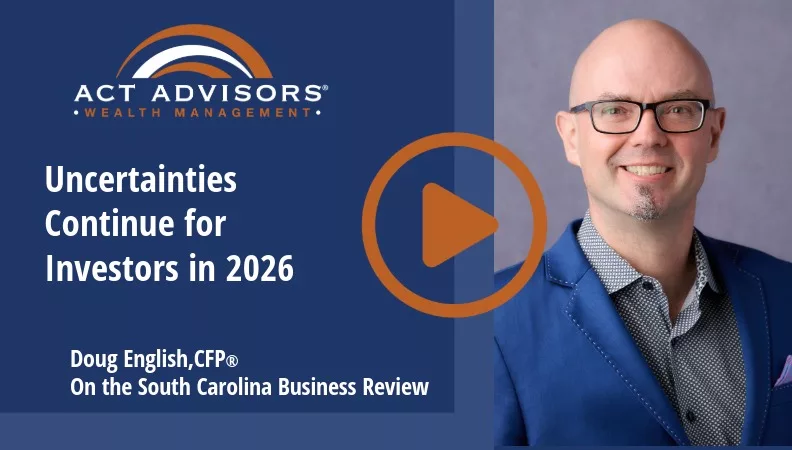
Doug English, Certified Financial Planner™ with ACT Advisors, recently joined South Carolina Business Review to share his perspective on what investors may want to consider in 2026. While no one can predict the future, Doug highlighted several historical trends and planning principles that may help investors stay grounded—especially when market headlines feel overwhelming.
A Historical Look at Bull Markets
One key point Doug shared is that the market is currently in the fourth year of a bull market—a phase that has often been positive historically.
Looking back at bull markets going back to 1950, the fourth year has typically seen gains, with just one exception in the 1940s, and even that downturn was relatively modest.
That doesn’t mean investors should expect a specific outcome or assume gains are guaranteed. These historical patterns are descriptive, not predictive, and market cycles don’t repeat in a uniform way. Still, the data shows that markets have often been able to maintain momentum at this stage of a cycle.
Why Interest Rates Still Matter
Another factor influencing investor expectations is the direction of interest rates.
Interest rates impact borrowing costs, business growth, and consumer activity—so changes from the Federal Reserve often play a significant role in market behavior.
Doug explained that when markets are moving upward and interest rates decline, market momentum has historically been supported. While conditions are never identical year to year, rate cuts have often been viewed as a tailwind for both businesses and investors, though their impact depends heavily on the broader economic backdrop.
The Bond Market: A Different Conversation Than Recent Years
Bond investors have experienced challenges over the past several years, largely due to rising interest rates and market volatility. However, Doug pointed to an important difference in today’s bond market environment: starting yields are higher than they were in recent years.
Doug explained that one of the best predictors of future bond returns is the yield you begin with. With the 10-year Treasury rate sitting above 4%, some bond investors may now expect bond returns to be higher than what was typical in the near-zero rate environment.
He also noted that if interest rates decline, bond prices can rise, which could potentially improve bond returns compared to a flat-rate environment. While outcomes vary depending on bond type, duration, and economic conditions, it’s a reminder that bonds may again serve as an important part of balanced, long-term portfolios.
Commodities, Gold, and “Hot” Trends: Proceed With Caution
It’s hard to ignore the uptick in gold and commodity discussions, especially when uncertainty rises. Television commercials and headlines often push the idea that commodities are a safer alternative.
Doug emphasized caution in this area—not because commodities are “bad,” but because they can be highly volatile.
Commodity investments often experience significant price swings, and their performance can be difficult to predict. Doug described the volatility of commodities as substantial, meaning investors can see sharp gains or sharp declines in a relatively short period of time.
For long-term investors, this is a useful reminder: chasing performance can increase risk, especially when market conditions change quickly.
Why Volatility Matters More Than Most People Think
Doug also shared an example that highlights a key risk for retirees and near-retirees: sequence of returns risk.
Even if long-term market returns are positive, experiencing poor returns early in retirement can put pressure on a financial plan—especially when withdrawals are happening at the same time.
Doug described a hypothetical scenario in which a Monte Carlo analysis showed a retirement plan with a high probability of success. If that same plan experienced several years of negative returns early in retirement, the probability of success declined significantly. Actual outcomes will vary based on individual circumstances.
The takeaway is simple and powerful: the market doesn’t have to “crash” for a retirement plan to be affected. A few difficult years—especially at the wrong time—can make planning more complex.
The ACT Advisors Perspective: Discipline Over Headlines
At ACT Advisors, we believe investing should be grounded in planning—not fear, hype, or the latest trend.
That includes:
Building diversified portfolios aligned to your goals
Managing risk thoughtfully
Stress-testing retirement plans against different market scenarios
Avoiding emotional decision-making in uncertain markets
Staying focused on what you can control
Markets will always involve uncertainty, and no single year comes with guarantees. But with a disciplined strategy and clear planning, investors can navigate volatility with more confidence and clarity.
Want to Review Your Investment Strategy for 2026?
If you’re wondering how inflation, interest rates, and market volatility could impact your investment plan this year, ACT Advisors can help you review how your current strategy is positioned under a range of economic scenarios.
Our approach is designed to support long-term goals with a focus on risk management, discipline, and data-driven decision-making.
Schedule a conversation with ACT Advisors to stress-test your plan and stay aligned with what matters most.
Disclosure: This material is provided for informational and educational purposes only and should not be considered investment, tax, or legal advice. Investing involves risk, including the potential loss of principal. Past performance is not indicative of future results.